

Exceptional students currently enrolled in an undergraduate degree program in the Department of Communication Studies are encouraged to apply to our Accelerated Bachelor’s/Master’s program (ABM). This program is open to all Communication Studies students regardless of their concentration that meet the criteria for admission.
How it Works
To accelerate progress through a master’s degree in the Department of Communication Studies, a limited number of graduate courses (up to 12 credit hours) may be counted as a Communication Studies electives towards both the completion of the undergraduate degree and the Communication Management graduate degree.
-
The Accelerated Master’s Program is for exceptional students. The accepted student will have:
- an average GPA of 3.5 (or better) in communication studies courses,
- an average GPA of 3.5 (or better) in all UAB courses,
- a minimum of 60 credit hours completed; 36 of these credit hours must have been taken at UAB
- completed at least one half of their communication course requirements.
Before applying, the student must meet with their Communication Management graduate program director, undergraduate advisor, and the concentration coordinator to discuss program requirements; students should also meet with a financial aid/scholarship advisor to determine the impact of ABM on their scholarships and/or aid award.
Students will submit their ABM application through the UAB Graduate School’s online portal. In addition, students must complete the Communication Management ABM program application form, and supply for review their official undergraduate transcripts, one letter of reference, a current C.V. or resume, and a personal statement.
Admission is by a committee chaired by the graduate program director, consisting of the graduate program director and the CMST concentration coordinator.
-
To maintain status in ABM, the student must:
- Maintain a 3.0 GPA average
- Maintain at least halftime-student status at UAB (with exceptions for medical emergencies)
Students will be withdrawn from the ABM program if they are unable to meet these requirements. If a student is withdrawn, they will retain credit for the courses already taken in the program.
Once students complete their B.A., they enter the M.A. program as a typical graduate student and must maintain the graduate program requirements.
-
To accelerate progress through the M.A. degree, up to 12 hours of M.A. courses may be counted as communication studies electives towards the completion of the B.A. degree and towards the completion of the M.A. degree.
All graduate may be used for undergraduate B.A. credit, excluding:
- CM 618 Independent Study1
- CM 675 Graduate Internship
- CM 698 Masters Applied Project
- CM 699 Thesis Research
CM 618, 675, 698, and 699 can only be use for the M.A. in CM, upon graduating with a B.A.
1CM 618 may be allowed in special circumstances with the approval of the ABM committee and the support of the faculty member directing the independent study. These cases are to be seen as exceptions and are generally to be discouraged.
-
Each student must develop a specific plan of study with the help and approval of the graduate program director and communication studies concentration coordinator. Students must adhere to this plan of study while in the program. Changes to the course of study may be made with approval.
The qualified Communication Studies student may complete the ABM in five years without recourse to summer courses. (availability of required classes in Broadcast, Public Relations and Sports Communication may alter progress in those concentrations). This is a sample plan only. Students may move faster or slower through the program depending upon a number of variables unique to their personal plan.
Year Fall Spring 1 CMST 105
UG CoreCMST 103
CMST 110
UG Core2 CMST 255
3 hour CMST electives6 hours CMST electives
UG CoreUG Core 3 CMST elective
CM 601
UG Core3 hours CMST elective
3 hours CM 6xx
UG Core4 3 hours CMST elective
CM6xx
UG CoreCMST 494
3 hours CM6xx
UG Core5 12 hours CM 6xx 6 hours CM 6xx
6 hour CM 698 (or two additional CM 6xx)

The Filmmakers Club at UAB is open to anyone who has an interest in film and media. The organization’s goal is to expand opportunities for students who would like to advance their knowledge, skills, and experience in filmmaking by collaborating and creating with other students. No previous experience is required – just a passion and interest in making films!
The Filmmakers Club hosts regular events throughout the year, including guest speakers, workshops, film production, film screenings, social gatherings, field trips, and lectures. The club also hosts the annual Magic City Shorts event in April, where student films are showcased in the Alumni Theater to a public audience.
The Filmmakers Club has periodically partnered with other organizations on campus for various events, so if you have ideas for collaboration, please let us know!

Contact Alan Franks at
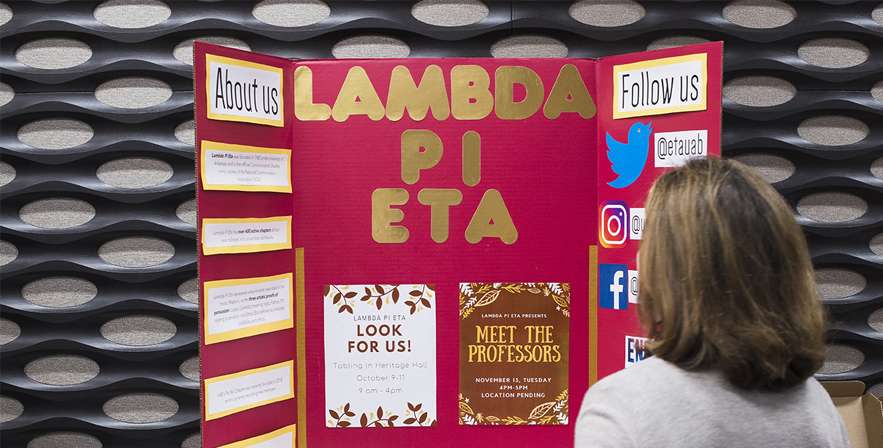
Lambda Pi Eta (LPH) is the National Communication Association’s official honor society at four-year colleges and universities. LPH has more than 500 active chapters at four-year colleges and universities nationwide.
LPH became a part of the National Communication Association in 1988, and the association's official honor society in July 1995. It is a member of the Association of College Honor Societies (ACHS).
LPH represents what Aristotle described in Rhetoric as three ingredients of persuasion: logos (Lambda), meaning logic; pathos (Pi), relating to emotion; and ethos (Eta), defined as character credibility and ethics.
Qualifications
- 45 Credit Hours (3.0 GPA)
- 12 Communication Credit Hours (3.25 GPA)
Goals
- Recognize, foster, and reward outstanding scholastic achievement in Communication Studies
- Stimulate interest in the field of Communication
- Promote and encourage professional development among Communication majors
- Provide an opportunity to discuss and exchange ideas in the field of Communication
- Establish and maintain closer relationships between faculty and students
- Explore options for graduate education in Communication Studies

The Public Relations Council of Alabama/Public Relations Student Society of America at UAB (PRCA/PRSSA at UAB) chapter is a strong student-led group for students in any major who have an interest in joining an award-winning team of young professionals that can add standout experiences to your resume! This organization offers valuable skills in networking and building communication skills and leadership experiences which apply to any career path.
PRCA/PRSSA at UAB has won the Public Relations Council of Alabama Student Chapter of the Year for 39 of the last 41 years!
In 2024, UAB brought home 9 Medallion Awards (the highest award offered by PRCA), 10 Awards of Excellence and 17 Awards of Merit. In 2024 the chapter also won the Outstanding Chapter Award, Chapter Campaign Award, Best Chapter Award, Community Service Award, and Chapter Website Award from Alabama PRSA. One of our students received the PR Strategist Award and Wordsmith Award. Another student won Best of Show and one student placed second for the Student of the Year Award. Students won three group awards recognizing their campaigns representing local nonprofit organizations in the community. One student won the Judge's Choice Award for her individual contribution to the campaign and three students won Judge's Choice Awards for their firm's campaigns.
 The chapter has also received the STAR chapter award from the Public Relations Student Society of America for the last six years. In 2023, the chapter received the prestigious Dr. F. H. Teahan National Chapter Award for Chapter Firm.
PRCA/PRSSA at UAB is an extremely active group, always looking for young professionals who wish to excel in this field! The organization conducts workshops, hosts panels and networking events, and participates in service-based learning in the community.
As a member of the PRCA/PRSSA at UAB, students will have the unique opportunity to network and share ideas with fellow peers and local public relations professionals. Education and professional development are key elements to the success of this organization.
For more information, contact the faculty advisor, Dr. Jacquelyn S. Shaia at


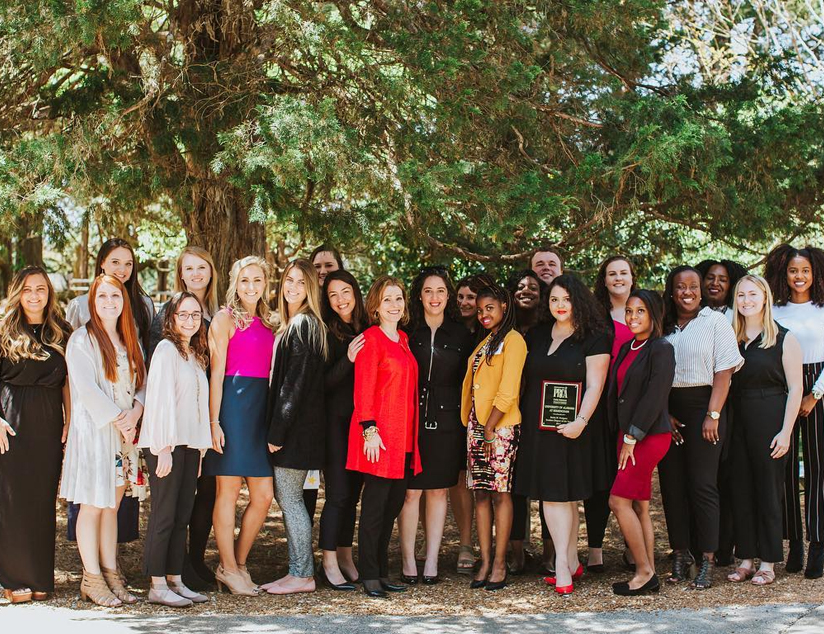
PRSSA/PRCA
PRSSA/PRCA is a strong student-led group for public relations majors. PRSSA/PRCA is an extremely active group, always looking for young professionals who wish to excel in this field! The organization conducts workshops, hosts panels and networking events, and participates in service-based learning in the community.
Learn More
Lambda Pi Eta
Lambda Pi Eta (LPH) is the National Communication Association’s official honor society at four-year colleges and universities. LPH has more than 500 active chapters at four-year colleges and universities nationwide.
Learn More
Student Media Club
The BEA Student Media Club is open to anyone who has an interest in media, whether TV, radio, film, or digital media. The organization’s goal is to broaden opportunities for students who would like to advance their knowledge, standing, and connection in the media industry by linking students with industry professionals, faculty, and other students who hold similar interests.
Learn MoreThe Honors Program in Communication Studies offers an enhanced and challenging academic experience for exceptional and highly motivated undergraduate students, especially those considering graduate school. Students who complete the program will graduate with "Honors in Communication Studies.”
Eligibility
To be eligible, a student must be a declared Communication Studies major and must have a cumulative, institutional, and Communication Studies GPA of 3.5 or above.
Requirements
- Fulfill the normal requirements for the Communication Management major or Mass Media concentrations.
- Submit a completed Communication Studies Honors Program application form to the Director of Departmental Honors for approval. Students must secure the permission of the Director and their mentor in order to enter the Communication Studies Honors Program.
- Maintain and graduate with a cumulative, institutional, and Communication Studies GPA of 3.5 or above.
- Successfully complete and defend (no later than four weeks before graduation) an Undergraduate Honors Thesis conducted under the supervision of a faculty member in the department.
Learn More
For more information and/or admission to the Communication Studies Honors Program, please contact:
Ahmet Atay, PhD
Professor and Department Chair
(205) 934-3877
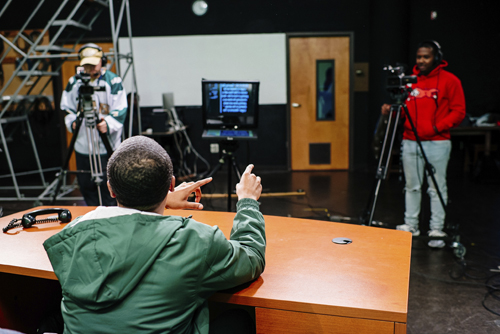 In a recent national survey of corporate recruiters, 86 percent identified “effective communication” as the most important professional skill they were looking for in prospective employees. Think about it: different jobs require you to do very different tasks. But what do they all have in common? Communication. This is why communication consistently is identified as one of the top skills employers seek in job candidates, regardless of industry.
If you desire a career in fields such as public relations, broadcasting, or journalism, we have specializations for you. But we also offer classes addressing almost every career imaginable. You can take classes on topics as diverse as nonverbal communication, communication in romantic relationships, visual media production, and public relations strategy. You will learn about effective presentations, social networks, media criticism, and news reporting. Whether you are a scientist or a salesperson, a medical researcher or a musician, desire a career in politics or sports marketing, communication skills will be an essential part of your job; and we are here to help you acquire and master those skills.
Below is a small sampling of some of the professions our majors go into:
-
Business
- Manager
- Personnel Recruiter
- Human Resources
- Training and Development
- Admissions Counselor
- Benefits Administrator
- Sales Representative
- Public Information Officer
- Negotiator
- Customer Service Representative
- Newsletter Editor
- Human Resources Manager
- Event Coordinator
- Mediator
- Buyer Chief
- Executive Officer
- Economic Development
- Nonprofit Manager
-
Journalism (print or electronic)
- Producer
- Writer
- Copy Writer
- Reporter
- Editor
- Newscaster
- Author
- Script Writer
- News Service Researcher
- Technical Writer
- Acquisitions Editor
- Media Interviewer
- Broadcast Journalism
-
Advertising
- Media Planner
- Media Buyer
- Creative Director
- Media Sales Representative
- Public Researcher
- Advertising Specialist
- Marketing Specialist
- Copy Writer
- Account Executive
- Manager
-
Public Relations
- Publicity Manager
- Advertising Manager
- Marketing Specialist
- Lobbyist
- Public Affairs Specialist
- Account Executive
- Development Officer
- Sales Manager
- Media Analyst
- Media Planner
- Creative Director
- News Writer
- Development/Fundraising
- Event Management/Consulting
- Public Opinion Researcher
- Nonprofit Event Specialist
-
Broadcasting & Digital Media
- Station Manager
- News Director
- Research Director
- Floor Manager
- Multimedia Journalist
- Reporter
- Video Editor
- Writer/Producer
- News Writer
- Creative Specialist
- Market Researcher
- Content Producer
- Promotions Manager
- Creative Services Director
- Show Director
- Programming Director
- Traffic Director
- Videographer
- Announcer
- Production Sound Mixer
-
Professional and Graduate Programs
- Communication
- Mass Communication
- Public Health
- Law/Business
- Health-related Professions
How We Help You
The faculty in the Department of Communication Studies take preparing you for your future very seriously. You will receive hands-on training for your future professions in many of our classes, such as Public Speaking (CMST 101), Newswriting and Reporting (CMST 210), or Conducting Public Relations Campaigns (CMST 442). Classes such as Communications and Teamwork (CMST 310), Organizational Communication (CMST 311), Communication Leadership and Management (CMST 315) and Interviewing (CMST 309) are specifically designed to provide you with the knowledge and skills necessary for success in the workplace. In fact, you’ll find that most of our curriculum has a strong, practical emphasis that prepares you for the communication challenges that lie ahead.
Where Should You Start?
Start your search here at UAB. To talk about professional opportunities in Communications, make an appointment with Jacquelyn S. Shaia. You can reach out to her at
 Career and Professional Development Services has job and internship listings, job fairs, resume builders, and many more resources for UAB students. We recommend that you take advantage of all that they have to offer.
In addition, there are plenty of other websites that can help you with your career search. Start with one of these:
One of the best things about UAB is its amazing diversity of its students — we are one of the topmost diverse campuses in the United States. We want you to have every opportunity to succeed in your coursework and college life. Here are eight easy tips for you to follow:
- Visit the UAB International Student and Scholar Services website. They have all sorts of forms, guides, and helpful links to make your life easier.
- Don’t be shy. Let your instructors know that English is your second language.
- Take advantage of class study groups. They let you go over material at your pace.
- Record lectures (with your instructors’ permission). Transcribe your recording to notes.
- Meet regularly with your advisor. They are experts and can help!
- Visit the UAB English Language Institute. They will give you assistance with both oral and written English.
- Visit the UAB Writing Center. They have tutors and instructional workshops.
- Frustrated and out of options? UAB counselors are there for you.
We invite you to explore all of the programs and services offered to international students. International Student and Scholar Services will be able to advise you about how to apply and who to contact for information. Please visit their website, or send general questions to
And remember — you are not alone! There are other international students/non-native English speakers in just about every class you take! Share your stories and help each other!