
Astronomy is a beloved science to the people of Birmingham, and students at UAB can learn about astronomy through formal study and student organizations.
The Physics Department at UAB offers a variety of astronomy courses (lecture/lab) in astronomy at the introductory level. Students may enroll in a lab during the same semester as the lecture counterpart, or in a later semester. The time commitment for each lecture course is 9 hours per week (3 credit hours), and 3 hours per week for the lab course (1 credit hour). Labs complement the lectures by introducing students to science process skills using lab kit materials sent to each student at the beginning of each semester. There are no prerequisites for these courses. They can be taken in any order based on students’ interests.
Students wishing to pursue a career in astronomy will be supported by completing a physics degree at UAB. Please consult with your academic advisor to learn about which physics track will best support your future study.
Dr. Michelle Wooten (
If you would like to know more about Dr. Wooten’s scholarship on dark sky studies, please visit her faculty profile.

Spring 2024 Astronomy 101 students show off recycled artwork they made during course activities.

Spring 2024 AST 101 students make recycled astronomy art.

Spring 2024 AST 101 students on a night hike at Oak Mountain State Park.

Getting ready to take measurements of campus lighting in GIS with Trimble data collectors. Left to right: Dr. Michelle Wooten (Campus SHINE at UAB Lab at UAB Leader), Kendal Colley (Jefferson County International Baccalaureate student), Spence Henderson (UAB Facilities), and Andrew King (UAB Facilities).


Ben Heine from UAB Facilities supervises UAB engineering students as they prepare to fly a drone they designed and built to capture sky quality measurements. These measurements will be studied as part of ongoing research by the Campus SHINE Lab, to assess how UAB campus lighting is impacting the local environment.

Kendal Colley (Jefferson County International Baccalaureate student) presents her collaborative research with Dr. Michelle Wooten on UAB crime data statistics from 2022 at the 2024 Alabama Academy of Sciences Conference.
Accelerated Bachelor’s/Master’s Programs (ABM) in Physics and Data Science
The UAB Department of Physics is addressing the national need for a 21st century quantum workforce with data fluency. To meet this need, we have developed two modern accelerated bachelor’s/master’s (ABM) programs that are now attracting national recognition:
- B.S. in Physics/M.S. in Data Science: The Physics/Data Science ABM is an interdisciplinary program jointly offered by the Department of Physics and the Department of Computer Science
- B.S. in Physics/M.S. in Physics: The Physics ABM is a research-intensive program that allows students to pursue undergraduate and graduate research while completing their Bachelor’s Degree and working toward their Master’s Degree
Why these ABM programs?
Today, we are living in the early days of the Fourth Industrial Revolution, powered in part by artificial intelligence (AI), quantum science and quantum engineering. We are witnessing a convergence of the physical, engineering and data sciences that is forcing companies across all industries to re-examine how they do business. The emergence of the Quantum Information era and Quantum Materials Science has led to the National Quantum Initiative. Training students in quantum physics, data science and advanced materials science is now necessary for preparing a new generation of Quantum Engineers and Data Scientists and for developing the workforce for advanced manufacturing and information technology industries. In addition to finding such highly-sought-after jobs, graduates of our accelerated B.S./M.S. programs can also pursue a Ph.D. degree in Physics if they wish.
Physics/Data Science Accelerated Bachelor's/Master's Program (ABM)
The Department of Physics (PH) and the Department of Computer Science (CS) jointly offer an interdisciplinary Accelerated Bachelor's/Master's program of study (ABM). This ABM leads to the accelerated completion of the B.S. degree in Physics (from the Department of Physics) and the M.S. degree in Data Science (from the Department of Computer Science), as compared to independent completion of these two degrees. The ABM program integrates undergraduate-level coursework from physics (B.S. in physics with computational physics concentration) and computer science (CS minor) with the requirements for the M.S. in data science.
How It Works
To accelerate progress through the B.S./M.S. degree, pertinent computational, M.S. level PH and CS courses may substitute the chemistry content (8 credit hours) of the conventional undergraduate PH major. Similarly, the 3 credit hours of the conventional Physics Capstone course may be substituted by the CS/PH 698 research. Alternatively, a limited number of M.S. courses (up to 12 credit hours) may be counted as general electives towards the completion of the B.S. degree in physics and towards the completion of the M.S. degree.
-
Admissions
The Physics/CS ABM Program is for exceptional students. The accepted student will have:
- GPA ≥ 3.5 in PH and CS courses,
- GPA ≥ 3.5 in all UAB courses,
- a minimum of 60 credit hours, and 36 of these credit hours must have been taken at UAB, and
- be ready to take an MS course in their next academic year.
Before applying to the Graduate School, the prospective ABM student should meet with Prof. Camata (Physics UG Program Director) and Prof. Chengcui Zhang (M.S. in Data Science Program Director), as well as with the PH and CS undergraduate advisors; students should also meet with a financial aid/scholarship advisors to determine the impact of ABM on their scholarships and/or aid award.
Next, students must complete the UAB Graduate School application for the M.S. in Data Science, which includes a personal essay summarizing their academic interests, career goals, and relevant background experience, as well as the submission of their resume or CV. Students must then complete the ABM Program Form (including all approvals) and pay the application fee. As a student submits their application to the Graduate School, they must also send their ABM form to Mellissa Taylor (
This email address is being protected from spambots. You need JavaScript enabled to view it. ), who is managing ABM applications.Upon acceptance, a detailed plan for the course of study must be developed that is specific to each Physics/CS ABM student. This plan must be agreed upon by all parties (student; PH undergraduate program director, CS graduate program director, and PH and CS undergraduate advisors). It must be strictly adhered to while in the Physics/CS ABM program to guarantee continued participation in the ABM.
Acceptance into the program is typically at the end of sophomore year. Admission is granted by a committee co-chaired by the CS graduate program director and the PH undergraduate program director. Additional members of the admissions committee include the CS and PH undergraduate academic advisors.
Before the first M.S. course is taken, the student must finish the requirements for the CS minor.
Application deadlines are as follows:
- Fall Admission: August 1
- Spring Admission: December 1
- Summer Admission: May 1
-
Program Requirements
To maintain status in the Physics/CS ABM, the student must:
- maintain a 3.5 GPA average in undergraduate PH and CS courses
- receive a B (or better) in the M.S. courses taken while still an undergraduate student, and
- maintain fulltime-student status at UAB (with exceptions for medical emergencies).
If any of these requirements is violated, the student will be withdrawn from the ABM program. If a student is withdrawn from the ABM program, they will retain credit for the courses already taken in the program.
Once the undergraduate has completed all course requirements for graduation, their undergraduate degree will be awarded.
Once the student graduates from the B.S., they enter the M.S. program as a regular M.S. student and must maintain the requirements of the M.S. program.
-
Courses
Physics/CS ABM Course No. Credit Hours UAB Core Area I - 6 Area II 12 Area III - N/A - Area IV - 12 Math Required Cal 1 MA 125 4 Cal 2 MA 126 4 Cal 3 MA 227 4 Intro Diff. Eqn. MA 252 3 Intro Lin. Algebra MA 260 3 Chem Acceleration feature: Computational and Data-Science Pertinent - - M.S. CS/PH 6xx-level courses may substitute Chemistry - 8 B.S. The World Through Data PH 103 3 Physics Required Topics in Contemporary Physics PH 110 1 Gen. Physics I: Mechanics PH 221 4 Gen. Physics II: Electricity & Magnetism PH 222 4 Gen. Physics III: Quantum Physics & Thermodyn. PH 223 4 Comp., Theory, Measurement in Quantum Physics PH 350 3 Mathematical Methods of Physics PH 420 3 Statistical Thermodynamics I PH 432 3 Classical Mechanics I PH 461 3 Electromagnetic Theory I PH 445 3 Introductory Quantum Mechanics I PH 450 3 Capstone Acceleration feature: Computational and Data-Science Pertinent - - CS/PH 698 research may substitute PH Capstone - 3 CS Minor Required Intro to Comp. Sci. CS 103/L 4 Obj-oriented Program CS 203/L 4 Discrete Structures CS 250 3 Alg. & Data Structures CS 303/L 4 Comp. Org. & Assembly Lang. Progr. CS 330 3 General Electives Acceleration feature: M.S. courses (up to 12 credit hours) may count as general electives towards completion of BS degree and MS degree - 12 M.S. Data Science Required Database Application Development CS 510 3 Introduction to Probability & Statistics in Computer Science CS 555 3 Advanced Algorithms and Applications CS 652 3 Machine Learning CS 667 3 Foundations of Data Science CS 685 3 CS or CS-approved elective CS 6xx 3 CS or CS-approved elective CS 6xx 3 CS or CS-approved elective CS 6xx 3 CS or CS-approved elective or Thesis CS 6xx 3 CS or CS-approved elective or Thesis CS 6xx 3 Undergraduate Hours 124 Graduate Hours 30 -
Typical Five-Year Plan
Qualified and motivated student may complete the Physics/CS ABM in 5 years without recourse to summer courses. The summers can be devoted to internships to enhance a student’s professional prospects [Frequency of CS 6xx course offerings may require adjustments to this plan.]
AY Fall Spring Summer 1st MA 125
PH 103
PH 110
CS 103/L
UG CoreMA 126
PH 221/L
CS 203/L
CH 115/L
UG Core2nd MA 227
MA 260
PH 222/L
CS 250
UG CoreMA 252
PH 223/L
CS 303/L
UG Core3rd PH 350/L
PH 420
PH 461
CS 330
UG CorePH 432
CS 510
CS 555
UG Core4th PH 445
PH 450
CS 652
CS667
UG CorePH 618
PH 499
CS 685
CS 6xx
UG Core5th CS 6xx
CS 6xxCS 6xx
CS 6xx
Research-Intensive Physics Accelerated Bachelor's/Master's Program
Interested in doing research? Looking for an employable degree? Excited about uncovering the basic understanding of 'how things work'? If you answered yes to these three questions, then the Physics ABM is for you. This is a new research intensive program that allows students to perform undergraduate and graduate research while completing their bachelor’s degree and working toward their master’s degree. The program will save both time and money by
- applying credit hours for selected classes to both the B.S. and M.S. degrees
- providing a Tuition Scholarship from the Department during M.S. studies
- Eligible students may also be awarded a teaching assistantship stipend while in the M.S. program, or be awarded a scholarship during their undergraduate years
This ABM requires intensive research training and experiential learning at the undergraduate level, in preparation for the M.S. The research is designed to lead to a successful defense of the M.S. thesis. A successful graduate will earn a bachelor’s degree and a master’s degree offered by the department of Physics within an accelerated time period as compared to the sequential completion of the two degrees. A student working toward a degree in any of the department’s five concentration may be admitted into the program. Mentored research will be supervised by approved faculty from the Department of Physics, as well as from other departments that include, but not limited to, Math, Computer Science, Materials Engineering, Biomedical Engineering, Chemistry, and Biology.
- Admissions
- Credit Sharing Policy
- Maintaining Status in the ABM
- Graduate Courses Allowed for Credit Sharing
-
Admissions
The Research-Intensive Physics ABM program encourages interested Freshmen and Sophomores to discuss with faculty whether the Physics ABM is the best path for them. Acceptance into the program is typically granted at the beginning of the junior year.
Before applying, the student must meet with the Physics graduate and undergraduate program directors, as well as with their undergraduate advisor, to discuss program requirements; students should also meet with a financial aid/scholarship advisor to determine the impact of the ABM on their scholarships and/or aid award.
The Academic Requirements are:
- a minimum average GPA of 3.5 in the Physics, Math, Chemistry and Engineering courses required for their Physics B.S.,
- a minimum average GPA of 3.5 in all UAB courses,
- a minimum of 60 credit hours, and 36 of these credit hours must have been taken at UAB
A student interested in entering the Research-Intensive Physics ABM should complete the ABM form AND an application to the M.S. Program in Physics. Both forms are available on the Graduate School website. The ABM application should be sent to Mellissa Taylor (
This email address is being protected from spambots. You need JavaScript enabled to view it. ); the M.S. application is automatically forwarded to the Graduate School.If accepted, ABM Students will be enrolled in both the Physics B.S. and M.S. programs. Before the first M.S. course is taken, the student must have finished their Physics course requirements, except for the 400-level Physics courses.
Upon acceptance, a detailed personalized plan of study must be designed for each Physics ABM student. This plan must be approved by the student, the Physics graduate program director, the Physics undergraduate program director, and the student’s physics undergraduate research mentor.
Admission is granted by a committee consisting of at least one member of the graduate admissions committee and the undergraduate program director. The committee will be chaired by the graduate program director or his/her appointed representative.
-
Credit Sharing Policy
To accelerate progress through the M.S. degree, a limited number of M.S. courses (up to 12 credit hours) may be counted as a Physics elective towards the completion of the B.S. degree AND towards the completion of the M.S. degree.
- The selected courses are typically courses in the B.S. program that are also cross-listed with graduate level courses for the M.S. program. See the below for a complete list.
- PH 698 (8 credit hours), Nonthesis Research, will be taken instead of undergraduate research courses such as PH 491, PH 491, PH 492, PH 495.
- The selected M.S. courses must be approved by the department.
-
Maintaining Status in the ABM
To maintain status in ABM, the student must:
- maintain a 3.5 GPA average in undergraduate Physics courses
- receive a B (or better) in the M.S. courses taken while still an undergraduate student, and
- maintain fulltime-student status at UAB (with exceptions for medical emergencies).
If any of these requirements is not met, the student will withdraw from the ABM program. However, they will still retain credit for the courses already taken in the program.
Once the undergraduate student has completed all course requirements for graduation, their undergraduate degree will be awarded. Once the student graduates from the B.S., they will complete the remaining requirements of the M.S. Physics Program, and then be awarded a master's degree in Physics.
Further information about these ABM opportunities may be obtained from Dr. Renato P. Camata, Undergraduate Program Director,
This email address is being protected from spambots. You need JavaScript enabled to view it. or Dr. Mary Ellen Zvanut, Graduate Program Director,This email address is being protected from spambots. You need JavaScript enabled to view it. . Additional details and online application are available through the UAB Graduate School Web Page. -
Graduate Courses Allowed for Credit Sharing
Any of the PH5xx and PH6xx courses offered, with approval of the department and their research mentor. These courses include the following:
- PH 518 Computational Solid State Physics
- PH 520 Introduction to Methods in Theoretical Physics I
- PH 532 Statistical Thermodynamics I
- PH 545/546 Electromagnetic Theory I/II
- PH 550/551 Introduction to Quantum Mechanics I/II
- PH 553/554 Solid State Physics I/II
- PH 561 Classical Mechanics I
- PH 575 Intro to Biophysics I
- PH 581/2 Laser Physics I/II
- PH 587 Nanoscale Science and Applications
- PH 610 Classical Mechanics I
- PH 618 Computational Solid State Physics
- PH 635 Advanced Statistical Mechanics
- PH 650/651 Electromagnetic Theory I/II
- PH 653/4 Solid State Physics I/II
- PH 660 Methods of Mathematical Physics
- PH 671/2 Quantum Mechanics I/II
- PH 698 Nonthesis Research
In summary, the typical student in the Physics ABM will follow the Junior and Senior four-year plan of their chosen Physics track such as that shown below; however, 600-level courses may be taken instead of the suggested 400-level courses. In addition, a student will enroll in PH 698 (up to 8 credit hours) instead of the undergraduate research courses PH 490, PH 491, PH 492, or PH 495, in order to accelerate their path to the Physics M.S. degree.
Junior First Term Hours Second Term Hours PH 350 4 PH 432 3 PH 420 3 PH 490, 491, or 495 1-4 PH 461 3 Track Electives (e.g., PH 423, PH 475, PH 486, etc.) 3-6 Track Elective (e.g., PH 336, PH 410, PH 487, etc.) 3 - - 13 - 7-13 Senior First Term Hours Second Term Hours PH 445 3 PH 446 or 466 3 PH 450 3 PH 451 3 PH 490, 491, 492, 495 1-4 PH 499 3 Track Elective (e.g., PH 418, PH 453, PH 481, etc.) 3 Track Elective (e.g., PH 454, PH 482, PH 497, etc.) 3
Data Fluency and Remotely Accessible Interdisciplinary STEMM Education
No one wants to spend a career looking over their shoulder as a robot is trained to do their work. The physics department of today must prepare students of all backgrounds for the Fourth Industrial Revolution. UAB Physics is doing its part to educate a generation that will look forward and lead. Our focus is on Emerging Technologies & Society, Reasoning with Data, and on civic science. UAB Physics students are equipped to use current and future technologies to address scientific and societal challenges.
In what ways can we prepare students to navigate and use emerging technologies? What skills should we prioritize as we prepare our students for the future?
In Physics, we emphasize the development of data fluency, i.e., the ability to use technology and data science to derive new knowledge. Data fluency goes beyond data literacy. When learning a new language, a literate person can read and speak, while a fluent person can use it to create a story or a poem. Our approach to 21st century education combines the development of data fluency with experiential learning in the experimental or computational Physics research lab.
Project RAISE
To facilitate the above goals, Dr. Lauren Rast leads project RAISE, Remotely Accessible Interdisciplinary STEMM Education. Rather than simply developing new online courses for life-long learning, RAISE explores innovative ways of using emerging educational technologies to advance participation in Science, Technology, Engineering, Mathematics, and Medicine (STEMM) fields and engage students with different backgrounds levels of past prepartion. In particular, RAISE provides a STEMM-personalized support framework not limited by geography to support all individuals, including those impacted by social, economic, educational, cultural, or other life circumstances. This framework empowers life-long learners to participate in 21st century job opportunities, now made possible through Physics. In recognition of success, Dr. Rast received the Provost’s Award for Transformative Online Courses.
The Magic City Data Collective
The Magic City Data Collective (MCDC) is a public-private partnership and model for our new UAB “City as Classroom” course housed in the department of Physics. Dr. Lauren Rast serves as Principal Investigator/Project Director for the Magic City Data Collective project, which was selected as an awardee for the Alabama Office of Apprenticeship Governor’s Work-Based Learning Best Practices Regional Awards, and is a Silver Medal winner in the 2024 International Economic Development Awards. “MCDC connects purpose-driven companies with future leaders in data. It is based in Birmingham, a destination for civic-minded talent.” MCDC gives students new internship opportunities for data fluency education in UAB Physics and hands-on data training and professional development with local employers and nonprofit organizations.
By expanding our department’s holistic educational approach, which earned the 2023 American Physical Society Improving Undergraduate Education Award, we foster self-efficacy, STEM affinity, and subject knowledge among disadvantaged students. Collaborating with university-wide initiatives, we aim to bridge the gap between high school readiness and the skills needed to excel in physics and STEMM jobs. This is essential for preparing our graduates to tackle the grand challenges facing the modern world and global society.
The Physics Major

UAB’s B.S. degree in physics is designed to prepare students for research in private sector and national labs, high-tech STEM careers, professional degree and graduate degree programs, and teaching careers.
As a recognition of the success of our major, the department won American Physical Society’s (APS) 2023 Improving Undergraduate Physics Education Award. Our program was chosen as a role model for liberal arts colleges for improving the educational experiences of undergraduate students. This national award recognizes our continuing success of recruiting a high number of physics majors, the research opportunities provided by our faculty, and our numerous major tracks that prepare students for a wide range of career paths.
The department offers a flexible experience for students, allowing them to choose courses geared to their specific interests.
For students interested in preparation for advanced graduate degrees in physics or mathematics, careers in industry, jobs requiring computational expertise, or pursuits in biomedical fields, the department offers focused concentrations (tracks) in their area of choice:
-
Physics Major - General
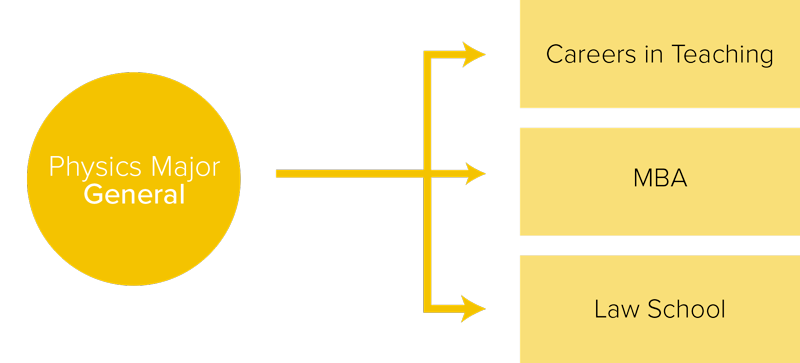
Through the Major in Physics (our "General Physics Track"), the department strives to fill a critical need for science teachers in Alabama and nationwide. Students interested in promoting STEM literacy and leading a new generation of physics students through a career in teaching are a great fit for this track. They will find a community of physics and science teachers in training through our partnership with UABTeach and UAB’s STEM Education Center. In addition, this track is suitable for students considering a career in business or law, including an MBA or patent law.
-
Physics Major - Advanced
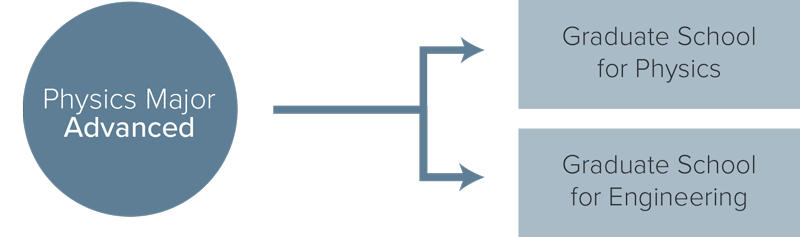
The Advanced Track prepares students for graduate studies in physics or related fields, such as engineering. The curriculum includes a sequence of conceptually challenging courses that build on the basics of core themes.
The courses studied in this track help students develop quantitative and analytic problem-solving skills that enable them to adapt to the changing career landscape and find employment in new and emerging fields. Available electives range from theoretical topics such as differential geometry and tensor calculus to those with more experimental applications like spectroscopy and laser technologies.
Departmental research opportunities train advanced physics students to target problems that blur the boundaries between physics and engineering, photonics, biomedicine, and materials sciences. This experience goes beyond the classroom to prepare them for a physics research career in today’s interdisciplinary research environment.
-
Physics Major - Applied
The Applied Track is primarily designed for those who want to develop the problem-solving skills to pursue careers in applied physics or engineering. This track is ideal for those interested in solving the many technological problems that exist in today’s world. While engineering focuses on well-defined techniques and applied physics generally concentrates on the development of new technologies, both sectors use practical scientific applications to benefit society.
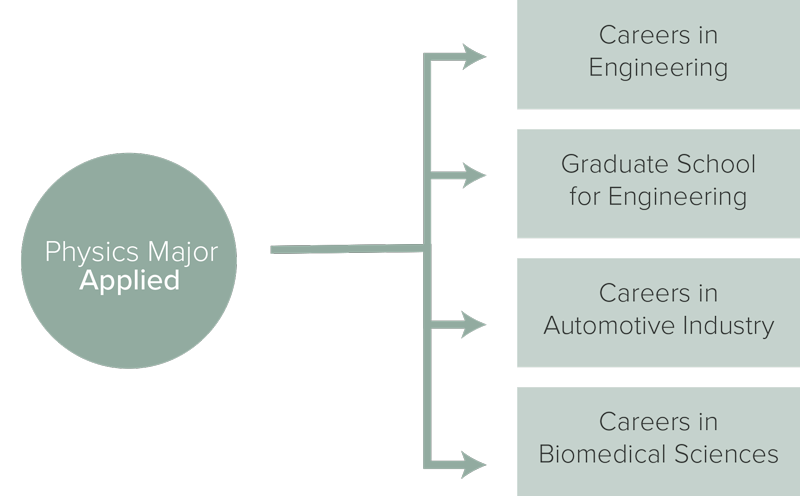
The applied track builds on the foundations of the basic curriculum and explores the use of physics in industry and other technological enterprises. Students interested in pursuing revolutionary breakthroughs in topics like fiber optics and nanotechnology are best suited for this track. Students interested in careers in engineering, the automotive industry, biomedical sciences, or graduate school in engineering.
Much of the research in this field has resulted in new and improved technology, including applications in medicine, engineering, photonics, energy, and defense.
-
Physics Major - Computational
Students who select the Computational Track will develop expertise in the areas of simulation of physical processes, data and experimental analysis, and mathematical reasoning. These valuable skills are essential components of modern research in particle physics, condensed-matter physics, astrophysics, fluid mechanics, quantum field theory, quantum chromodynamics, and plasma physics.
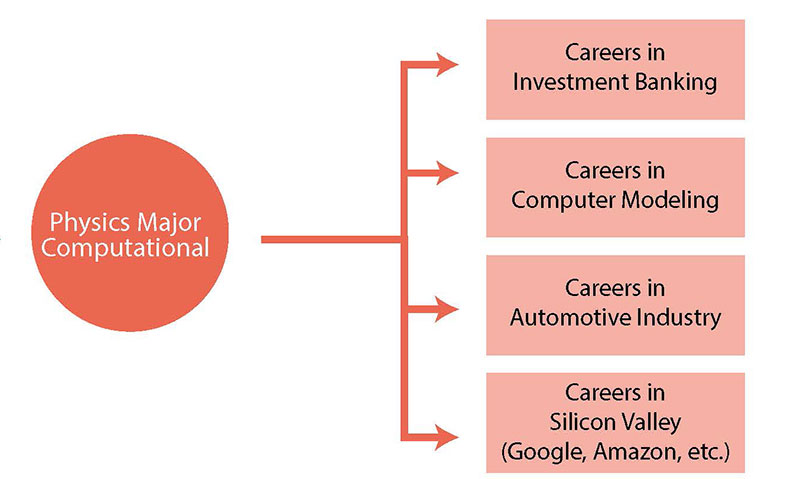
This curriculum not only focuses on advanced topics in physics, but also its relationship with computer science and mathematics. The use of algorithms and simulations to solve complex problems will prepare students for careers related to computer applications, such as computer modeling, investment banking, or the automotive industry.
This track aims to prepare students for new opportunities offered by developments in data sciences and exascale computing and is best suited for those hoping to pursue jobs in banking and finance, information science, and big data. Opportunities at large tech companies are rapidly expanding for students pursuing a concentration in computational physics.
-
Physics Major - Biophysics
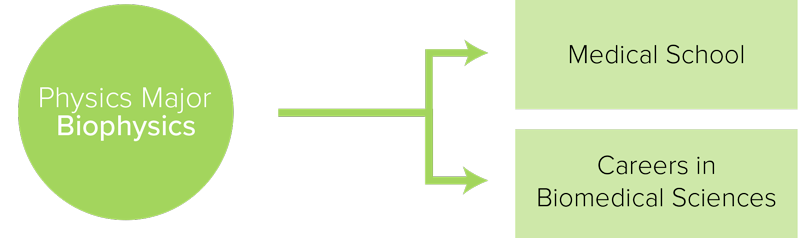
The Biophysics track offers a balanced mix of physics, chemistry, biology, and math courses and prepares students for careers in biology and medicine. The curriculum explores the ideas, instrumentation, and computational models of physics to understand living things and biological problems.
Research in this field ranges from the study of bodily systems to that of individual molecules and often has an enormous impact on medical technology. Methods like fluorescent imaging, electron microscopy, x-ray crystallography, and spectroscopy are utilized in the field of biophysics in order to answer questions that affect the daily lives of individuals.
While many students planning to attend medical school pursue their bachelor’s degrees in biology and chemistry, the average physics major scores much higher on the MCAT exam than students from either of these programs. The problem-solving skills and complex understanding of science and technology learned in the biophysics track is ideal for those seeking entrance into top medical schools.
However, the study of biophysics and its applications extend far beyond hospitals and doctor’s offices. Students interested in pursuing careers in cell biology, public health, pharmaceutical R&D, and many others will also find success after graduating from this program.
Learn more about job opportunities for Physics graduates
Honors Program
The Physics Honors Program offers students from all five tracks enhanced opportunities to develop the research, problem-solving and communication skills necessary to excel in a scientific career. By designing, describing, and defending a research project, the honors graduate will have a documented capacity for success in graduate school or in any career where scientific critical thinking, motivation, and accomplishment are valued.
The goal of the Physics Honors Program is to train capable undergraduates for uncommon accomplishment in academic research. The new physics honors graduate will have documented experience and productivity commonly found in second- or third-year graduate students. Ideally, the research project will result in publication and presentation at a national conference, giving the honors graduate strong credentials for graduate or medical/professional school, industrial research, science writing, or teaching. Contacts made through publication and conferences and informed references written by mentor and committee members give the honors graduate a significant edge in the job market. The successful honors student will be recognized at the UAB Honors Convocation and will graduate “With Honors in Physics.”
For additional information on the program, read the Eligibility & Requirements page in the Undergraduate Catalog or contact the Undergraduate Physics Program Director, Dr. Renato P. Camata.
Course Catalog
A complete list of program requirements, courses, and a proposed four-year program of study for physics majors are available in the UAB Undergraduate Catalog.
Undergraduate Program
Students who major in physics go on to successful careers in a variety of fields that impact both big research problems and the technology-based global economy. The UAB Department of Physics offers a rigorous but flexible undergraduate program. We emphasize both depth and breadth in order to meet the demands of tomorrow’s interdisciplinary research and education.
We are now witnessing a convergence of the physical, data, biological, human and mathematical traditional sciences. More and more, repetitive work is being taken on by computers that use Artificial Intelligence and Data Science techniques, such as Machine Learning. What is left for humans? Anything that requires creativity and critical thinking. Research has shown that, when combined with more specialized training, five skills are of the greatest value to today’s employers. These are what you could call "21st century skills":
- problem-solving,
- critical and creative thinking,
- collaboration,
- communication and
- ethical reasoning and mindset.
Our UAB program is especially designed to develop these complex skills together with the more technical skills rooted in Physics. Such combination makes workers most competitive for high-demand, high-paying jobs in the science, technology, engineering, mathematics and medicine (STEMM) fields.
Building a Signature Resume and Skillset
In order for our students to develop the skills that employers desire and Grand Challenge interdisciplinary research problems demand, the UAB Department of Physics offers five different undergraduate tracks whose objective is to build a competitive student skill-set and curriculum vitae. Our tracks are designed to help students achieve their career goals not only in traditional physics, but also in closely-related data science, engineering, teaching, business, and medical fields.
Undergraduate physics students may take a specific cluster of courses that align with one of our tracks—General Physics, Advanced Physics, Applied Physics, Computational Physics, or Biophysics. This more personalized and targeted approach allows our students to tailor their degree to their own interests and develop a specialization within the field, giving them a competitive edge over their peers after graduation.
All of our areas of focus place an emphasis on excellence and innovation. We train our students to use critical thinking and systematic analysis to understand complex theories and solve today's scientific problems. Our students develop complex skills both in the classroom and inside the experimental and computational lab. Our students are well-connected to industry and well-prepared to serve a fast-changing and technology-driven society.
Experiential Learning and Faculty Mentoring
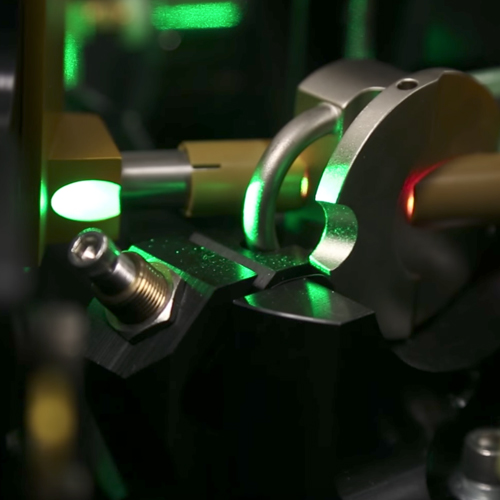
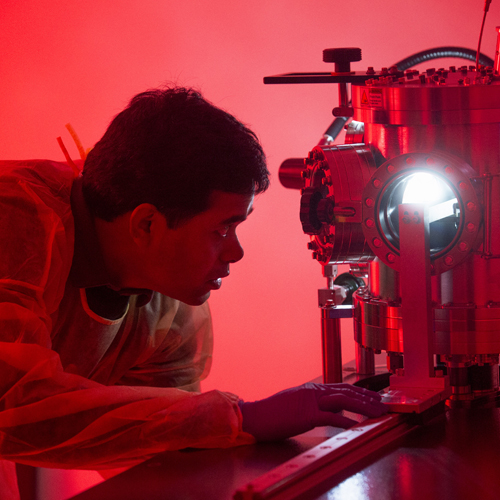
While theory is essential to a successful career in physics, we believe that conducting top-level hands-on research early in your undergraduate career is a vital part of a good physics education. Experiential learning in the research lab gives students a competitive advantage over their peers.
Our students are given the opportunity to work in faculty research labs, publish peer-reviewed papers on their research, and present their findings at national and regional conferences. This unique opportunity has allowed our students to compete on the highest level for entrance into the country’s top graduate programs and medical schools, and land prestigious jobs at world-renowned companies, national labs, and agencies. You don’t graduate our program by simply watching a professor talk. You must be a problem-solver, work effectively in teams, have STEM content knowledge, must be a self-directed learner and must make ethical decisions.
With our Faculty Mentoring System, we focus our students on developing a unique skill-set that will distinguish them in the marketplace. All physics majors meet regularly with their Faculty Mentor, who specializes in the Physics Track and career path that best meets the student’s individual interests. This Physics faculty mentor will guide the student to design the most effective course sequence that best fits his/her individual interests and aspirations. In addition, the mentor will connect the student with physics research, provide academic support and career guidance, and see the student through graduation. This aspect of our undergraduate program goes beyond typical academic advising to give all of our students with diverse backgrounds and preparation both the knowledge and the opportunities they need to succeed while in school and after they graduate.
Scholarships
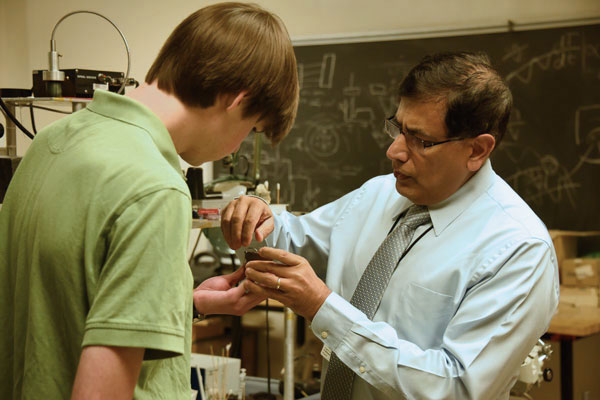
The Department of Physics has funding available for need-based and academic scholarships for each academic year. Please make sure you read the requirements and guidelines for these scholarships before submitting an application. UAB provides additional scholarship opportunities for entering freshmen and transfer students, both resident and non-resident.
The Robert and Edith Bauman Endowed Scholarship in Physics
The Robert and Edith Bauman Endowed Scholarship in Physics is open to incoming students, or students currently enrolled in the Department of Physics. Candidates must have demonstrated solid academic promise and have an overall grade point average of at least 3.0. Preference will be given to the most promising entering students. The scholarship is an annual award. Recipients may re-apply for the award in subsequent years as long as they maintain the required 3.0 grade point average. Majoring in physics is a requirement for receiving and maintaining this prestigious scholarship. Bauman recipients who change to a major other than physics will have their award rescinded.
The Edward L. Wills Endowed Scholarship in Physics
The Edward L. Willis Endowed Scholarship in Physics is available for students currently enrolled in or admitted to a degree-granting program in the Department of Physics. Applicants must demonstrate solid academic promise and achievement and have earned at least an overall 3.0 grade point average in coursework completed prior to the time of application. The scholarship is an annual award. Recipients are eligible to apply for the award in subsequent years as long as they maintain the required 3.0 grade point average.
The Evan Garrison Memorial Endowed Award in Physics
The Evan Garrison Memorial Endowed Award in Physics is available for students who are currently enrolled in or admitted to a degree-granting undergraduate program within the Department of Physics at UAB. Applicants must demonstrate solid academic achievement and leadership qualities. They must have earned an overall 3.0 GPS or higher in coursework completed prior to their application. These funds shall provide support to students for whom affordability may be an obstacle, and who might otherwise be unable to attend the University. Preference will be given to applicants who have attended a public Alabama High School. This is an annual award. Recipients are eligible to apply for the award in subsequent years as long as they continue to meet scholarship requirements. In order to receive this award, students must be enrolled full time in course work required for their Physics degree program during the semester of designated disbursement. Students not meeting these conditions will have their scholarship terminated.
The Dr. Lowell Wenger Endowed Scholarship
The Dr. Lowell Wenger Endowed Scholarship in Physics is an annual award available to currently enrolled UAB students majoring in physics. To be considered for the scholarship, you must submit the BSMART scholarship application no later than midnight, March 1st. To be eligible you must have at least a 3.0 overall GPA.
Apply for all of the scholarships above
Alabama Space Grant Consortium Scholarship
Applicants for this scholarship must be enrolled full-time in a program of study in the UAB Department of Physics. They must have a specific research project relevant to a NASA Mission Directorate, commercial space, and/or the ISS U.S. National Lab.
Applicants for this Undergraduate Scholarship must meet the following requirements:
- A United States citizen
- Pursuing a bachelor’s degree in Physics of interest to NASA, commercial space or the ISS
- Enrolled as a full-time student at the UAB Department of Physics and classified as a junior or senior
- In good academic standing with a GPA of at least 3.0 (out of 4.0).
Amount: This scholarship award is limited to a maximum of $1,500 student stipend (or $750 for one semester)
Apply at https://www.uah.edu/asgc
Physics Research Opportunities Scholarship
Scholarships are available for our exceptional Physics majors who are looking to enhance their UAB research experience and their CV by participating in the research labs of our Physics professors. Please contact the department chair.
Other Scholarships
The university and UAB's College of Arts and Sciences offer many other scholarships to incoming and current students. You can explore these options and apply through https://uab.scholarships.ngwebsolutions.com/CMXAdmin/Cmx_Content.aspx?cpId=1444
Advising
No matter how good a student you are, having good advice is essential to your academic success. Students are assigned College of Arts and Sciences advisors based on their status as a freshman, sophomore, junior, or senior.
Physics students are also given advising through the department's Faculty Mentoring System. All physics majors meet regularly with a faculty mentor that specializes in the Physics Track that best meets their interests. This mentor will guide the student to develop the most effective course sequence that best fits his/her individual interests and aspirations. In addition, the mentor will connect the student with research, provide academic support and career guidance, and see the student through graduation. This aspect of the program goes beyond typical academic advising to give our students both the knowledge and the opportunities they need to succeed while in school and after they graduate.
Incoming and Transfer Students

The College of Arts and Sciences' Academic Advising website has everything you need — advice, contact information, and all kinds of helpful links.
If you are a new student, meet with your advisor before signing up for classes. The hardest part of your first year should be your classes, not deciding what they should be. Take the easy way out: Make an appointment to talk or meet with your academic advisor before you attend New Student Orientation.
Contact
Current Students
You can rely on your academic advisor for information, assistance, and encouragement throughout your time at UAB. In general, advisors will:
- help you identify your goals and develop educational plans to reach them
- help you understand degree requirements, course selection, and schedule planning
- refer you to resources across campus that can boost your academic performance
- help you understand academic policies and procedures
- provide information about potential areas of study
Please email
Student Groups
Society of Physics Students (SPS)
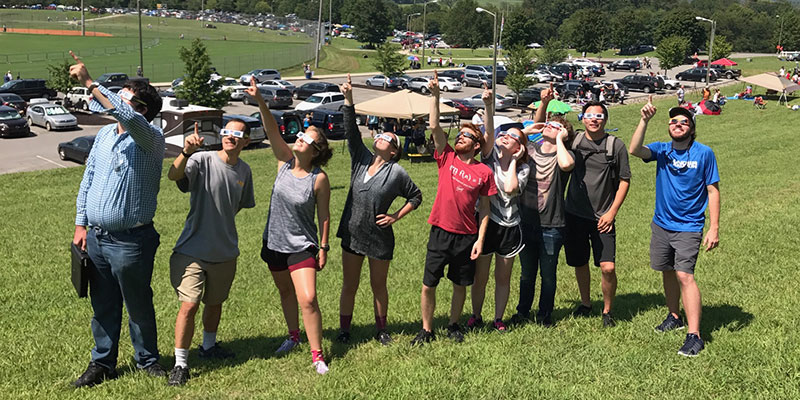 The SPS is the professional society for physics students and their mentors. UAB's chapter of the Society of Physics Students seeks to promote the advancement and expansion of physics knowledge by participating in social, academic, and outreach events that benefit the local and academic communities while introducing students to the professional community. This student organization is focused on student engagement and retention and on helping students. Find practical information on what to do with a degree in physics and how to apply for jobs and internships as well as for graduate school.
Our students and faculty advisors encourage and assist other students interested in physics to develop the knowledge, competence, enthusiasm, and social responsibility that are essential to the advancement of physics and for pursuing the 21st century career opportunities available to physics graduates.
Membership is open to all persons interested in physics. Any student, both graduate and undergraduate, at the University of Alabama at Birmingham is recognized as a student member. Any other person interested in being a member of the Society of Physics Students, but is not currently a student, is recognized as a non-student member.
See video of our 2017 Eclipse expedition
The Astronomy Club at UAB
Are you interested in learning about astronomy through social outings with other students? Members of the Astronomy Club at UAB come from a variety of majors including dentistry, sociology, physics, genetics, etc. They all share a love for star gazing and celebrating the night sky. Here are some of the activities the Astronomy Club at UAB participates in on a yearly basis:
- Observing celestial objects like the Moon and stars through telescopes
- Astronomy Game Nights
- Astronomy Movie Nights
- Guest speakers on astronomy topics
- Astronomy Crafts
- Impromptu, unofficial camping trips
We’d love to have you join us! You’re officially a member after joining us for two club meetings during a given year. Club leader elections take place in the spring.
- Current club president: Zach Wedlund , Contact:
This email address is being protected from spambots. You need JavaScript enabled to view it. - Faculty Advisor: Dr. Michelle Wooten, Contact:
This email address is being protected from spambots. You need JavaScript enabled to view it.


-
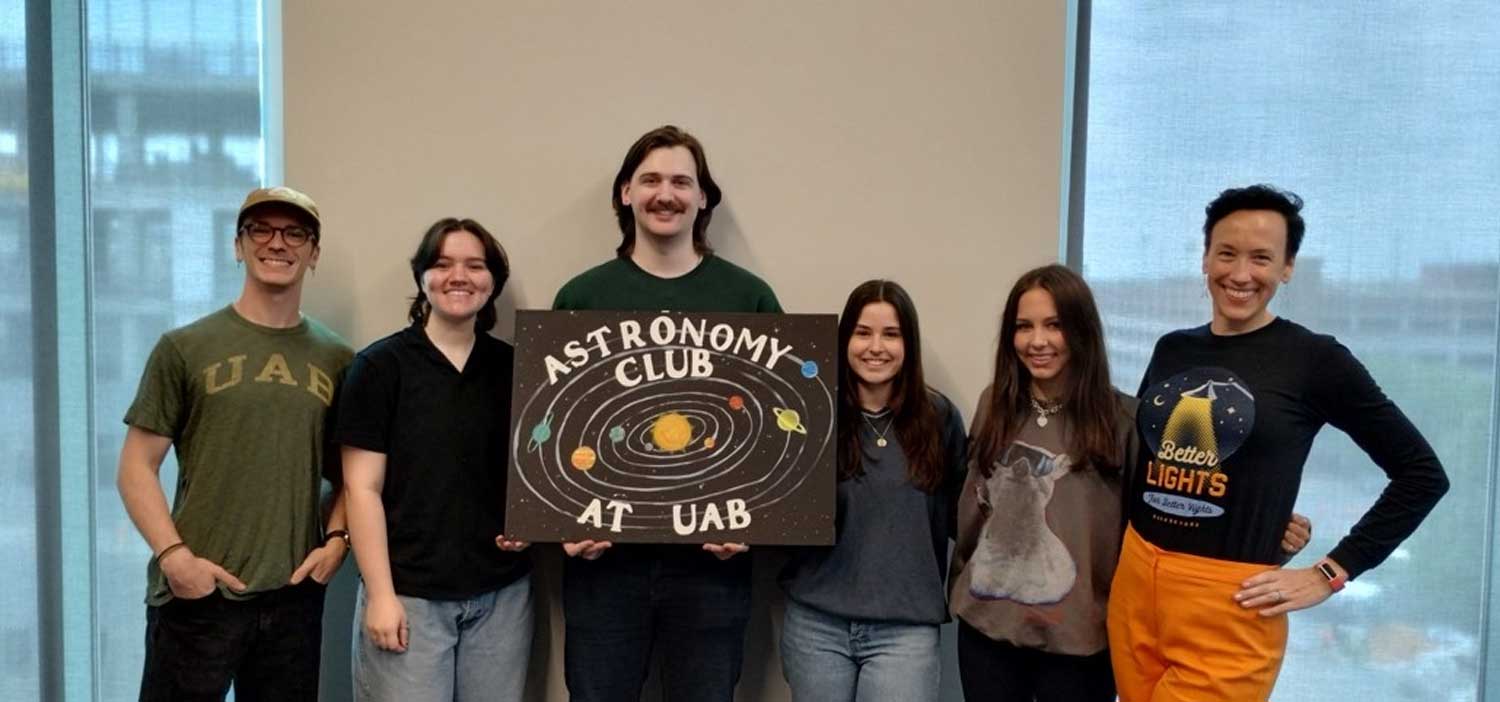
Current UAB Leadership: Zach Wedlund (Immunology), Sara Smith (Sociology), Christian Pierce (Information Systems), Sydney Hewitt (Genetics and Genomics), Zosia (Physics). Faculty Advisor: Michelle Wooten (Physics)
-
UAB students line up to get eclipse glasses from the Astronomy Club at UAB during the April 8, 2024 eclipse.
-
UAB students view the eclipse through eclipse glasses from the Astronomy Club at UAB during the April 8, 2024 eclipse.
International Students
One of the best things about UAB is its amazing diversity of its students. We value every student and the richly different perspectives, characteristics, and life experiences that contribute to UAB’s unique environment. We want you to have every opportunity to succeed in your course work and college life. Here are eight easy tips for you to follow:
- Visit the UAB International Student and Scholar Services website. They have all sorts of forms, guides, and helpful links to make your life easier.
- Don’t be shy. Let your instructors know that English is your second language.
- Take advantage of class study groups. They let you go over material at your pace.
- Record lectures (with your instructors’ permission). Transcribe your recording to notes.
- Meet regularly with your advisor. They are experts and can help!
- Visit the UAB English Language Institute. They will give you assistance with both oral and written English.
- Visit the UAB Writing Center. They have tutors and instructional workshops.
- Frustrated and out of options? UAB student counselors are there for you.
We invite you to explore all of the programs and services offered to international students. International Student and Scholar Services will be able to advise you about how to apply and who to contact for information. Please visit their website, or send general questions to
And remember — you are not alone! There are other international students/non-native English speakers in just about every class you take! Share your stories and help each other!
The Physics Minor

The Department of Physics offers a minor that is attractive for students required to take General Physics I & II as part of their major.
The physics minor enables students to gain an introductory understanding of Quantum Mechanics and its applications in chemistry, biology, engineering, and other applied sciences, as well as Einstein’s Special and General Theories of Relativity. This higher level of knowledge is accomplished by taking General Physics III: Thermodynamics & Quantum Physics and six additional semester hours of upper division physics courses of the student’s choice.
Course Catalog
A complete list of minor requirements and courses are available in the UAB Undergraduate Catalog.