
Graduate Programs
Ready to take your studies to the next level? Our graduate students have the opportunity to choose from a diverse portfolio of research topics and techniques in:
- Computational and Theoretical Physics
- Experimental Condensed Matter and Materials Physics
- Experimental Optics and Laser Physics
To prepare our students to make the future breakthroughs in research, we teach them the basics of emerging fields on quantum materials, quantum optics and quantum computation. To make our graduates more competitive for industry jobs, we provide them with hands-on experiences with high tech instruments and machine learning applications. To focus our training, we have developed four M.S. course threads:
- Materials Physics,
- Computational Physics,
- Instrumentation, and
- Spectroscopy.
Numerous Research and Training Opportunities
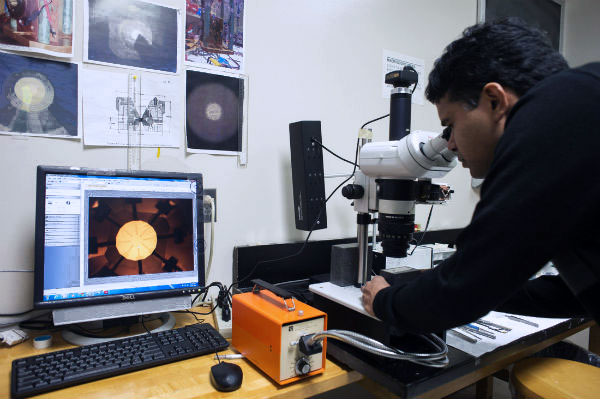
Our students receive training in cutting-edge technologies and computation, by pursuing one of the three focus areas of our research program, where the Department of Physics has established excellence and international recognition:
- High Performance Computing, Modeling, and Simulation of Quantum Materials
- Advanced Materials under Extreme Environments and Stimuli
- Lasers, Optics, and Photonics
In addition, the department hosts three collaborative research centers and programs:
- Center for Nanoscale Materials and Biointegration (CNMB) directed by Yogesh K. Vohra.
- ULTRA, Ultra Materials for a Resilient, Smart Electricity Grid, a Department of Energy EFRC Center that supports a consortium of universities focused on understanding the fundamental phenomena that determine the properties of materials being developed for a resilient, smart electricity grid. The UAB component is led by Mary Ellen Zvanut.
- IRES: Nanofibers for Resource Efficiency is a UAB research & training program supported by the National Science Foundation International Research Experiences for Students program. Andrei Stanishevsky leads this global engagement training effort, where Physics students perform research in European laboratories. This UAB-wide program has been recognized with the Provost’s Award for Faculty Excellence in Education Abroad.
Physics graduate students also have the opportunity to collaborate with national laboratories, including Oakridge National Laboratory, Los Alamos National Laboratory, Sandia National Laboratory, the Lawrence Livermore Laboratory, the National High Magnetic Field Laboratory, Ames Laboratory, and the Naval Research Laboratory.
Research at UAB Physics is not confined within the borders of the United States. Our Ph.D. students have the opportunity to work with prominent scientists and research centers across the world.
Contact
Any questions about our graduate programs can be directed to the graduate program director Dr. Shane Aaron Catledge.
International Students
One of the best things about UAB is its amazing diversity of its students. We value every student and the richly different perspectives, characteristics, and life experiences that contribute to UAB’s unique environment. We want you to have every opportunity to succeed in your course work and college life. Here are some easy tips for you to follow:
- Visit the UAB International Student and Scholar Services website. They have all sorts of forms, guides, and helpful links to make your life easier.
- Don’t be shy. Let your instructors know that English is your second language.
- Meet regularly with your professors. They are experts and can help!
- Visit the UAB English Language Institute. They will give you assistance with both oral and written English.
- Visit the UAB Writing Center. They have tutors and instructional workshops.
- Consider Graduate School classes for professional development.
- Make friends with fellow graduate students and work in your campus office.
- Frustrated and out of options? UAB student counselors are there for you.
We invite you to explore all of the programs and services offered to international students. International Student and Scholar Services will be able to advise you about how to apply and who to contact for information. Please visit their website, or send general questions to
And remember — you are not alone! There are other international students/non-native English speakers in graduate programs across campus.
Assistantships & Fellowships
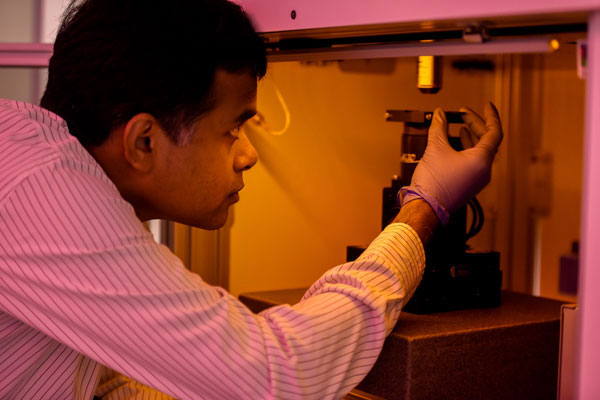
A stipend of $26,000 is provided for most admitted students through a variety of assistantships and fellowships. This stipend increases to $27,000 and $28,000 as the student progresses to Ph.D. candidacy.
As described below, special fellowships may provide larger stipends for highly qualified students, and the department offers supplemental support for select first year students. In addition, tuition and the cost of health insurance for graduate students are usually paid for by the Department, research grants, and/or fellowships.
Department & College Assistance
-
Blazer Graduate Research Fellowship in Physics
Applicants to the Ph.D. program in Physics, who have demonstrated exceptional promise in research and scholarship, will be considered for the UAB Blazer Fellowship. Fellowship recipients will receive a stipend of $26,000 + tuition and health insurance. Furthermore, they will be able to engage in research at the beginning of their first year with no teaching duties. It is expected that the Blazer Fellow will be able to commence Ph.D. research and choose a research mentor by the end of their first year.
For information about the application, contact the Physics Graduate Program director.
-
Teaching Assistantship (TA)
During the academic year new TAs will be assigned teaching duties consisting of introductory laboratories or recitations. A senior graduate student shares the laboratory during the first semester to assist you. Explanation of responsibilities and discussion of teaching methods are provided throughout the year by the department and the UAB Graduate School. Contact the graduate program director for updated or additional information.
-
Research Assistantship (RA)
In select cases you may be admitted with research support from a specific professor. In these instances, you must work closely with your advisor on the research project as well as maintain high academic standards. Some students who begin with teaching assistantships transition to RA status during the first few years of their graduate work. For further information, please contact the graduate program director.
-
Supplemental Support for Select First Year Students
Support for summer research prior to your first year of study and additional support for supplies during your first year may be available under special circumstances. For further information, please contact the graduate program director.
Special Fellowships
-
U.S. Department of Education: Graduate Assistantships in Areas of National Need (GAANN)
The U.S. Department of Education has funded the UAB Department of Physics to support the department's doctoral students in their academic pursuits. The funding supports five physics PhD students at a stipend level up to $34,000, depending on the financial need of the applicant as assessed by the UAB Office of Financial Aid. The GAANN program also makes an annual institutional payment of $15,213 per student.
The project title for the UAB physics program is "Doctoral Fellowships in Nanoscale Materials and Computational Physics at the University of Alabama at Birmingham." This distinctive program will lead to a PhD in physics involving individualized academic course work, closely supervised research experiences, optional industrial internships, continuous development of pedagogical and communication skills, and comprehensive supervision and evaluation of teaching performance.
Learn more about the basics of the GAANN program at the U.S. Department of Education website.
-
Alabama Space Grant Consortium Fellowships
Awards from this NASA-sponsored program are granted up to $37,000 — a $24,000 student stipend, up to $12,000 for tuition/insurance, and $1,000 for student travel allowance. These grants are made initially for one 12-month period and may be renewed annually for a maximum total award of 36 months (three years) of support. To be eligible you must be:
- a US citizen
- enrolled full-time in good academic standing (a GPA of at least 3.0 on a 4.0 scale) at an Alabama Space Grant Consortium (ASGC) member university pursing any space-related field of graduate study (master's or Ph.D. level).
Once the grant is awarded you must conduct a specific faculty-mentored research project that has NASA or aerospace relevance. You cannot receive funds from any source for work other than that defined by your approved proposed research and plan of study for which the award is made (supplements to the award may be made by UAB using funds from any source, provided the amount and source are disclosed in advance). You must also complete an extramural NASA experience sometime during the fellowship year. The experience details should be worked out with your faculty advisor and the NASA lab facility where you plans to participate in a research activity. It is advisable that a NASA contact be found prior to submission of the fellowship proposal. Fellows are expected to be involved in ASGC outreach activities and submit a final report at the end of the award period.
The online application is located on the ASGC website. When applications are closed you will still be able to view a sample application form and a sanple letter of recommendation form.
Other Financial Aid Opportunities
Other financial resources available are listed on the UAB's Graduate School website:
Contact
Any questions about our graduate programs can be directed to the graduate program director Dr. Shane Aaron Catledge.
Graduate Admissions
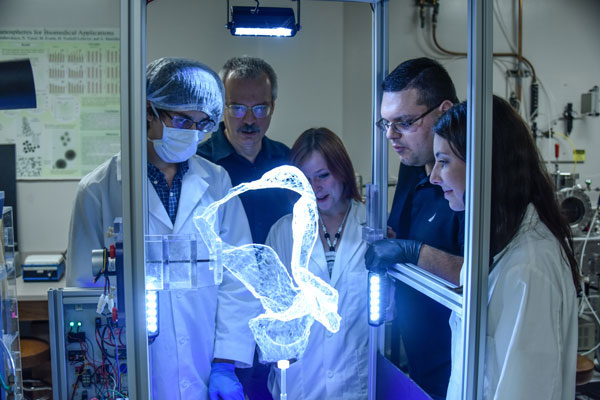
Admission into the physics graduate program is by recommendation of the graduate admission committee of the Department of Physics. The committee takes into consideration the following:
- an undergraduate degree in physics or a related field
- prior academic performance in physics courses
- a personal statement of career goals
- prior research experience
- letters of recommendation
- optional: verbal and quantitative scores on the GRE
Students may enter our program at the beginning of any semester. Assistantships and other financial support are mostly allocated to the students entering in the Fall semester.
Application Information
Students are accepted into the program during the Fall or Spring of each year. Students are strongly encouraged to submit their completed application materials to the Graduate School no later than July 1 for Fall admission and November 1 for Spring admission. If you are interested in obtaining financial assistance in the form of, for example, a teaching assistantship or a Blazer fellowship, you are encouraged to apply by early March. Assistantships are typically distributed by the end of April.
A completed application includes the following:
- application for admission
- payment of application fee (domestic applicants and green card holders, $50; international applicants, $60)
- transcripts from all post-secondary institutions the student attended
- three letters of recommendation
- a personal statement
GRE scores are optional. If you have taken the test and would like to send scores, please use Institution code 1856.
Application for admission can be made online through the UAB Graduate School website. For concentration, choose ‘not applicable.'
The Graduate School requires an official transcript from every institution that you have attended. The mailing address to send official transcripts is:
UAB Graduate School
LHL G03
1720 2nd Avenue South
Birmingham, AL 35294-0013
International Students
International students are encouraged to consult with the UAB Graduate School before submitting their application to our Graduate Program. TOEFL and TWE are required for all international applicants whose native language is not English. Minimum scores:
- TOEFL: 80
- IELTS: 6.5
- PTEA: 53
Electronic transfer code for submission of TOEFL scores is 1856.
The admissions committee will review your application after the above information has been submitted. If admitted, the following will also need to be provided:
- Financial Affidavit of Support
- Immigration documentation if currently residing in the U.S.
Graduate Catalog
Read about the Physics program and course descriptions in the Graduate Catalog.
Questions?
Contact the graduate program director Dr. Shane Aaron Catledge.