
My dad’s birthday cake consisted of one box of powdered sugar, two sticks of butter, two packages of cream cheese, PLUS four hours of labor. This masterpiece would be devoured by some in less time than it took to make it. Others would enjoy one piece and be done. Mary Katherine Osborn, however, would look not at the cake, but at the people, and wonder why some seem to have more control over their eating than others.
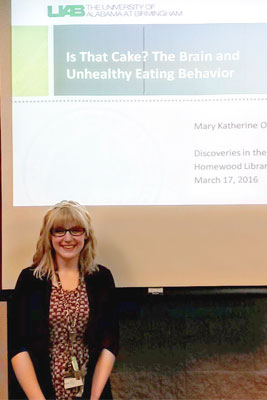 Osborn is a UAB graduate student in behavioral neuroscience whose research focuses on the brain and eating disorders, and specifically on an eating disorder that doesn’t receive much attention -- binge eating disorder, or BED. In her Discoveries in the Making presentation on March 17, 2016, at Homewood Library, she explained how her research offers insight into what goes on in the brains of people with BED and how altering their brain activity can change their behavior.
How does the brain affect how we eat?
There are different parts of the brain that correspond to carrying out particular tasks. The dorsolateral prefrontal cortex, or DLPFC, is the front part of the brain whose function is to make judgements and plan. This area is what keeps us from laughing at funeral, and also what allows us to control our eating and not reach for another slice of cake.
So what exactly is BED?
Binge eating is when someone eats a large amount of food in a short amount of time and experiences a loss of control. People with BED often hide their eating from others, and feel guilty after binging. They eat rapidly, when not hungry, and to the point of being uncomfortably full. While many of us do this occasionally (think Thanksgiving), people with BED do this frequently, sometimes every day. Currently there aren’t many effective treatments for BED, but Osborn’s research may work to change that.
The Test
People who are able to control their eating behavior have increased activity in their prefrontal cortex (that judgment making part of the brain that contains the DLPFC), while those with BED have a decrease in activity in their prefrontal cortex. Osborn and her research team decided to use transcranial direct current stimulation (tDCS) -- a machine that passes an electrical current into the brain--to increase activity in the DLPFC and test whether this would affect people’s eating behavior.
They brought people into the lab with binge eating disorder and had one real and one fake 20 minute session of tDCS. They did not tell participants which test was real and fake to avoid any biased or voluntary change in participants not caused by the actual tDCS treatment.
Results
Participants who experienced tDCS, after experiencing real stimulation, ate less of their preferred food than those who did not receive treatment when offered (under the guise of a flavor preference test to avoid partial results). They also reported less food cravings after being shown pictures of food, and a decrease in the desire to binge eat lasting the rest of the day of treatment. Interestingly, the participants who were most affected were males.
So What?
Osborn suggests that the impressive results from tDCS after just one 20-minute session could be used as a supplement to existing treatments. Osborn hopes to take her research further into this exciting treatment prospect by studying effects of long-term tDCS treatment, its effect on people with obesity, and the difference in effectiveness between males and females.
BED sufferers, have hope -- Osborn and her brain machine are making gains to recovery.
To learn more about exciting research endeavors by UAB graduate students, check out Discoveries in the Making online, and attend a presentation in local Hoover and Homewood libraries.
