As part of the requirements for OT 750: Scholarly Inquiry I and OT 751: Scholarly Inquiry II, our entry-level OTD students must design and complete a scholarly study to demonstrate their mastery of key elements of quantitative and qualitative research design relevant to occupational therapy practice.
We invite you to explore the range of topic areas presented by our OTD students in these posters.
2022: OTD 1
 Trauma-Informed Care and Adolescents
Aja Amison, OTS, Brittany Bell, OTS, Jennifer Calano, OTS, Maria Jimenez, OTS, Car’Daijah Lewis, OTS, & Ashley Smith, OTS
The Impact of Yoga on Mental Health: A Systematic Review
Eleese Anthony, OTS, Heidi Bridges, OTS, Peyton Brown, OTS, Christina Morgan, OTS, Hannah C. Turner, OTS, & Meredith Wheeler, OTS
Exploring the Impact of Expressive Therapies on Military Veterans With PTSD
Jane Frances Armour, OTS, Anna Brooke Livingston, OTS, Michaela Pass, OTS, Sarah Bailey, OTS, Savannah Ray Ryan, OTS, & Alison Nicole Sortino, OTS
Sensory Integration Therapy and Occupational Performance in Children with Autism
Keira Ashford, OTS, Denae Baker, OTS, Ajah Griffin, OTS, Charslyn Patterson, OTS, & Kaylie Williamson, OTS
Megan Brooks, OTS, Jalysia Donaldson, OTS, Sadie Hare, OTS, Carlee Leatherman, OTS, Katherine Brian Martin, OTS, & Anna Page Thacker, OTS
Haley Browning, OTS, Allie Davis, OTS, Bethany De Lisle, OTS, Macey Lane Holbrook, OTS, Kaisey Showers, OTS, & Hannah R. Turner, OTS
The Effects of Sport Participation on Psychosocial Health of Youth: An Updated Systematic Review
Madison Gaston, OTS, Melissa Pontius, OTS, Nicole Fernandez, OTS, Amanda Crowell, OTS, McKenzie Williams, OTS, & Allie Harpman, OTS
Baleigh Nelson, OTS, Katie Jackson, OTS, Priya Patel, OTS, Ashley Harris, OTS, Allie Dillard, OTS, & Conley Day, OTS
Annie Ozment, OTS, Grace Graves, OTS, Annie Pipkin, OTS, Makayla Shoots, OTS, Molly Welsh, OTS, & Sydney Wright, OTS
Rachel Summerlin, OTS, Hannah Wilson, OTS, Sadie Rucker, OTS, Emma Sullins, OTS, Maggi Welch, OTS, & Mackenzie Steger, OTS
Our master of science in occupational therapy program has admitted its last class, and we are no longer accepting applications for this program.
We now offer the Entry-Level Clinical Doctorate in Occupational Therapy (OTD) program, which is designed for students with bachelor’s degrees in fields other than occupational therapy. Learn more about and apply to our entry-level OTD program.
The Master of Science in Occupational Therapy degree program is designed to lead to a professional licensure in Occupational Therapy. While there is a national professional exam, National Board for Certification in Occupational Therapy (NBCOT) examination, associated with the occupational therapy licensure, specific licensure requirements still vary from state to state. UAB is working to develop an online, publicly-accessible database to assist in providing this state-by-state information. In the meantime, if you are interested in learning about potential professional licensure requirements in your state for a specific degree program, please contact UAB State Authorization at
The UAB Entry-Level Occupational Therapy Doctoral (OTD) degree program is fully accredited by the Accreditation Council for Occupational Therapy Education (ACOTE).
Ranked #20 in the nation by U.S. News & World Report (USNWR), our Entry-Level Clinical Doctorate in Occupational Therapy (OTD) program is also among the top 12 public university programs in the United States.
Top 20 National Program
We are a top-20 national program distinguished by the scale and collaboration of our environment. Housed within one of the nation’s largest health professions schools and the UAB Academic Health Center, the program offers students an experience that combines academic rigor with interprofessional education, faculty-led specialty clinics, and advanced study pathways in low vision rehabilitation, trauma-informed practice, and rehabilitation science.
In the USNWR rankings we are the:
- #1 Best Occupational Therapy Program in Alabama
- #6 Best Occupational Therapy Program in Southern States
- #20 Best Occupational Therapy Program in the United States
UAB offers unusual academic breadth in occupational therapy, spanning the entry-level OTD, post-professional OTD, PhD in Rehabilitation Science, a Low Vision Rehabilitation Graduate Certificate, and a trauma-focused graduate certificate.
ACOTE
Contact ACOTE
7501 Wisconsin Avenue, Suite 510E
Bethesda, MD 20814
301-652-6611
Accreditation Website
The UAB Entry-Level Occupational Therapy Doctoral (OTD) degree program is accredited by the Accreditation Council for Occupational Therapy Education (ACOTE) of the American Occupational Therapy Association (AOTA).
ACOTE® is recognized as the accrediting agency for occupational therapy education by both the United States Department of Education (USDE) and the Council for Higher Education Accreditation (CHEA). ACOTE® is also an active member of the Association of Specialized and Professional Accreditors (ASPA).
ACOTE® is recognized as the accrediting agency for occupational therapy education by both the United States Department of Education (USDE) and the Council for Higher Education Accreditation (CHEA). ACOTE® is also an active member of the Association of Specialized and Professional Accreditors (ASPA).
Read the full accreditation statement.
ACOTE Accreditation Status: Accredited
Graduation Data
The inaugural cohort of students in UAB’s Entry-Level Clinical Doctorate in Occupational Therapy (OTD) program graduated in December 2023.
Graduation Rate
| Graduation Year | Students Entering | Students who withdrew, or did not graduate with the entering cohort, for reasons other than academic performance | Students Graduating | *ACOTE Graduation Rate |
|---|---|---|---|---|
| 2023 | 60 | 1 | 54 | 91% |
| 2024 | 60 | 0 | 58 | 96% |
| 2025 | 58 | 1 | 49 | 86% |
| Total | 178 | 2 | 161 | 91% |
*The number of students who graduated according to the published program length. If a student does not graduate according to the published program length, the student should not be counted as a graduate for ACOTE graduation rate reporting.
Certification
Graduates of the program are eligible to sit for the national certification examination for the occupational therapist administered by the National Board for Certification in Occupational Therapy (NBCOT). After successful completion of this exam, the individual will be an Occupational Therapist, Registered (OTR). In addition, all states require licensure in order to practice; however, state licenses are usually based on the results of the NBCOT Certification Examination. Note that a felony conviction may affect a graduate’s ability to sit for the NBCOT certification examination or attain state licensure.
To learn more, visit the NBCOT website.
NBCOT
Our passing percent data is calculated on the number of New Graduates who passed the NBCOT exam regardless of the number of attempts during the testing year to meet ACOTE’s reporting standard.
NBCOT Success Rate
The first class to graduate from UAB’s entry-level OTD program began sitting for the National Board for Certification in Occupational Therapy (NBCOT) examination in January 2024.
This is the data for OTD graduates on the NBCOT examination within the stipulated reporting window of one year from graduation. Our passing percent data is calculated based on the number of new graduates who passed the NBCOT exam regardless of the number of attempts during the testing year to meet ACOTE’s reporting standard.
| Exam Period | % of New Graduates Who Passed Exam |
|---|---|
| Jan. – Dec. 2024 | 91% |
| Jan. – Dec. 2025 | 94% |
| Jan. – Dec. 2026 | NA |
National Board for Certification in Occupational Therapy (NBCOT®) program data results: https://www.nbcot.org/Educators-Folder/SchoolPerformance.
International Students
One of the best things about UAB is its amazing variety of its scholars — we are home to more than 2,000 international students, scholars and visitors annually. We want you to have every opportunity to succeed in your course work and college life. Here are some easy tips for you to follow:
INTO UAB Initiative
Are you an international student interested in attending UAB? Explore the INTO UAB initiative.
- Visit the UAB International Student and Scholar Services website. They have all sorts of forms, guides, and helpful links to make your life easier.
- Don’t be shy. Let your instructors know that English is your second language.
- Take advantage of class study groups. They let you go over material at your pace.
- Record lectures (with your instructors’ permission). Transcribe your recording to notes.
- Meet regularly with your advisor. They are experts and can help!
- Visit the UAB English Language Institute. They will give you assistance with both oral and written English.
- Visit the UAB Writing Center. They have tutors and instructional workshops.
- Frustrated and out of options? UAB counselors are there for you.
We invite you to explore all of the programs and services offered to international students. International Student and Scholar Services will be able to advise you about how to apply and who to contact for information. Please visit their website, or send general questions to
And remember — you are not alone! There are other international students/non-native English speakers in just about every class you take! Share your stories and help each other!
Advising
No matter how good a student you are, having good advice is essential to your academic success. Students are assigned College of Arts and Sciences advisors based on their status as a freshman, sophomore, junior, or senior.
The College of Arts and Sciences' Academic Advising website has everything you need — advice, contact information, and all kinds of helpful links.
Incoming and Transfer Students
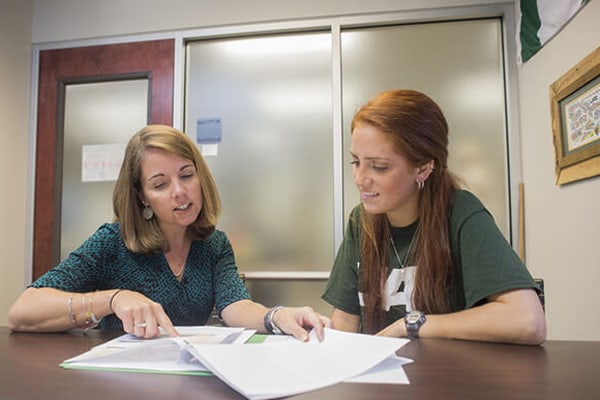
If you are a new student, meet with your advisor before signing up for classes. The hardest part of your first year should be your classes, not deciding what they should be. Take the easy way out: Make an appointment to talk or meet with your academic advisor before you attend New Student Orientation.
Contact the College of Arts and Sciences Advising Office at (205) 934-6135 for help with registering but also with making the most of your choice to attend UAB!
Current Students
You can rely on your academic advisor for information, assistance, and encouragement throughout your time at UAB. In general, advisors will:
- help you identify your goals and develop educational plans to reach them
- help you understand degree requirements, course selection, and schedule planning
- refer you to resources across campus that can boost your academic performance
- help you understand academic policies and procedures
- provide information about potential areas of study
Visit the College of Arts and Sciences Advising Office to find contact information for the Physics advisor.