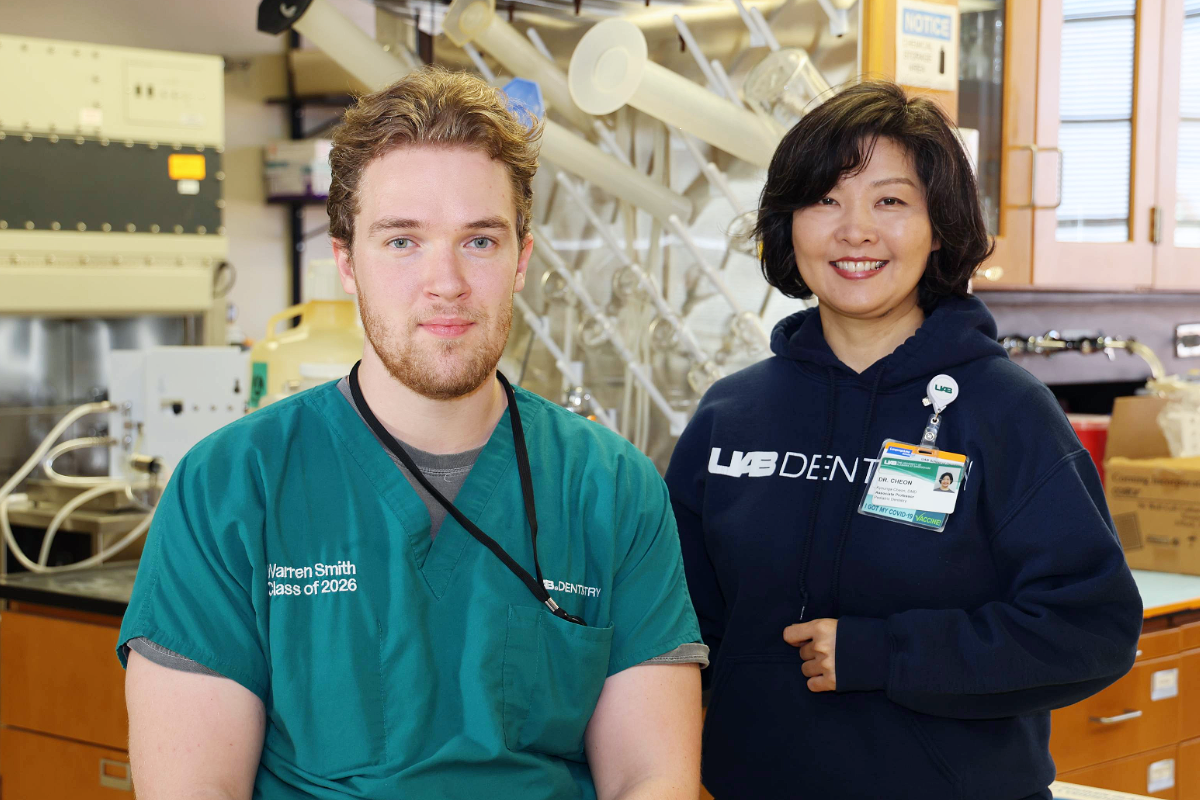
 Picture left to right: Warren Smith (Class of 2026) and Dr. Cheon, Pedodontics Faculty and Researcher at UAB SODPreserving pulp vitality and promoting natural tissue regeneration are gaining traction as key priorities in pediatric dentistry. Dr. Kyounga Cheon, DMD, MS, a researcher at the University of Alabama at Birmingham School of Dentistry, is leading an interdisciplinary initiative to develop bioactive materials that enhance healing while reducing the need for invasive dental interventions in children.
Dr. Cheon’s research focuses on engineering a biomimetic system that combines nitric oxide (NO)-releasing peptide amphiphiles with hydroxyapatite (HA) composites. These materials are designed to support the regeneration of pulp-dentin and bone tissues through biologically informed, minimally invasive therapies. “My research aims to address the critical challenge of preserving dental pulp vitality following injury or early-stage caries,” Dr. Cheon explains. “Under conventional treatment, these conditions often lead to progressive degeneration and pulp removal. The therapies we’re developing seek to support natural healing and preserve tooth structure and function.”
Although initially focused on pulp vitality, Dr. Cheon’s work has since expanded to include periodontal and peri-implant tissue regeneration. The implications are especially significant in pediatric dental care, where maintaining the health of primary and erupting permanent teeth is essential to normal jaw development, occlusion, and long-term oral function. “By maintaining pulp vitality, we facilitate the natural maturation of teeth and reduce the need for complex restorative procedures later on,” she emphasized.
To accomplish these goals, Dr. Cheon’s research draws from multiple disciplines, including tissue engineering, materials science, and translational model development. Her team is designing and evaluating NO-releasing and HA-fortified gels for their compatibility with dental tissues, their ability to promote angiogenesis, and their anti-inflammatory and regenerative properties. The research involves advanced in vitro cell culture systems, animal models, and extensive chemical and physical testing of the biomaterials.
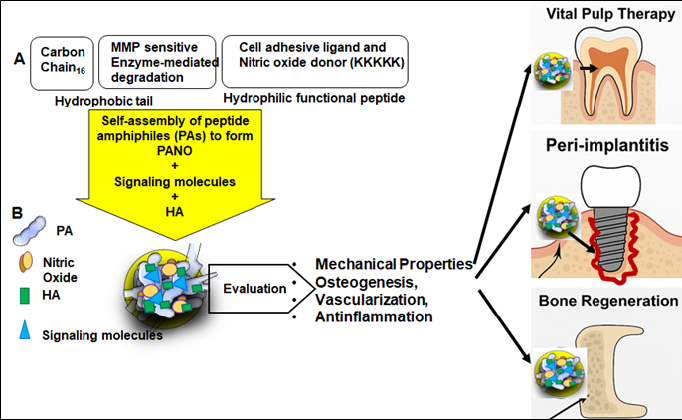 A diagram from Dr. Cheon’s research showing the impact of bacterial biofilms and their implications in vital pulp therapy failure, the progression of peri-implantitis, and effect on bone regeneration.One of the most striking discoveries has been the synergistic effect of NO-releasing gels and HA nanoparticles in promoting dentinogenesis. These combinations not only support the vascular networks essential for pulp healing but also outperform conventional materials in encouraging healthy tissue growth. “Our results show promise in enhancing regenerative outcomes while minimizing inflammation, which opens the door to more effective and biologically favorable therapies,” Dr. Cheon says.
Her research carries implications beyond pediatric dentistry. The same strategies could also be applied to endodontics for permanent teeth, periodontal regeneration, and craniofacial bone repair, offering wide-ranging benefits across oral and maxillofacial care.
Dr. Cheon’s work has been recognized nationally and internationally. She has presented at major conferences including the International Association for Dental Research (IADR), the American Association for Dental, Oral, and Craniofacial Research (AADOCR), the American Academy of Pediatric Dentistry (AAPD), and the Biomedical Engineering Society (BMES). Her findings have been published in high-impact journals such as the Journal of Dental Research, Pediatric Dentistry, and Applied Sciences. The dental research community has responded enthusiastically, with media features in Physics World and Dental Tribune, and the formation of industry partnerships aimed at further developing her novel biomaterials.
For dental students and young professionals interested in research, Dr. Cheon emphasizes the importance of curiosity, perseverance, and mentorship. “Get involved early and connect with mentors who can guide you,” she advises. “Start small, ask questions, and don’t be afraid to try something unfamiliar. Research is a long road, but the reward is seeing your work directly improve patient care.”
Reflecting on her own path, Dr. Cheon notes the importance of interdisciplinary collaboration. “I wish I had realized sooner how much progress can be made at the intersections of different fields. Working across disciplines and building strong professional relationships, nationally and internationally, has opened doors I hadn’t imagined.”
Looking ahead, Dr. Cheon’s team is developing bioactive materials that can dynamically respond to the changing conditions of the pulp microenvironment. This includes creating standardized platforms to streamline the development and clinical translation of these materials. She is especially enthusiastic about upcoming NIH proposals focused on direct pulp capping therapies using the NO-HA composite system. “The ultimate goal is to deliver more predictable, regenerative treatments that align with how tissues heal naturally,” she says.
Dr. Cheon also hopes her research will contribute to a broader shift in pediatric dentistry. “There needs to be a greater emphasis on prevention and biologically driven therapies that preserve and regenerate dental tissues. By applying the principles of bioengineering, we can better support natural tooth development and give young patients a healthier start that lasts into adulthood.”
Story originally published in Vol IV, Fall 2025 Bridging the Gap, a newsletter of the UAB Local Student Research Group.