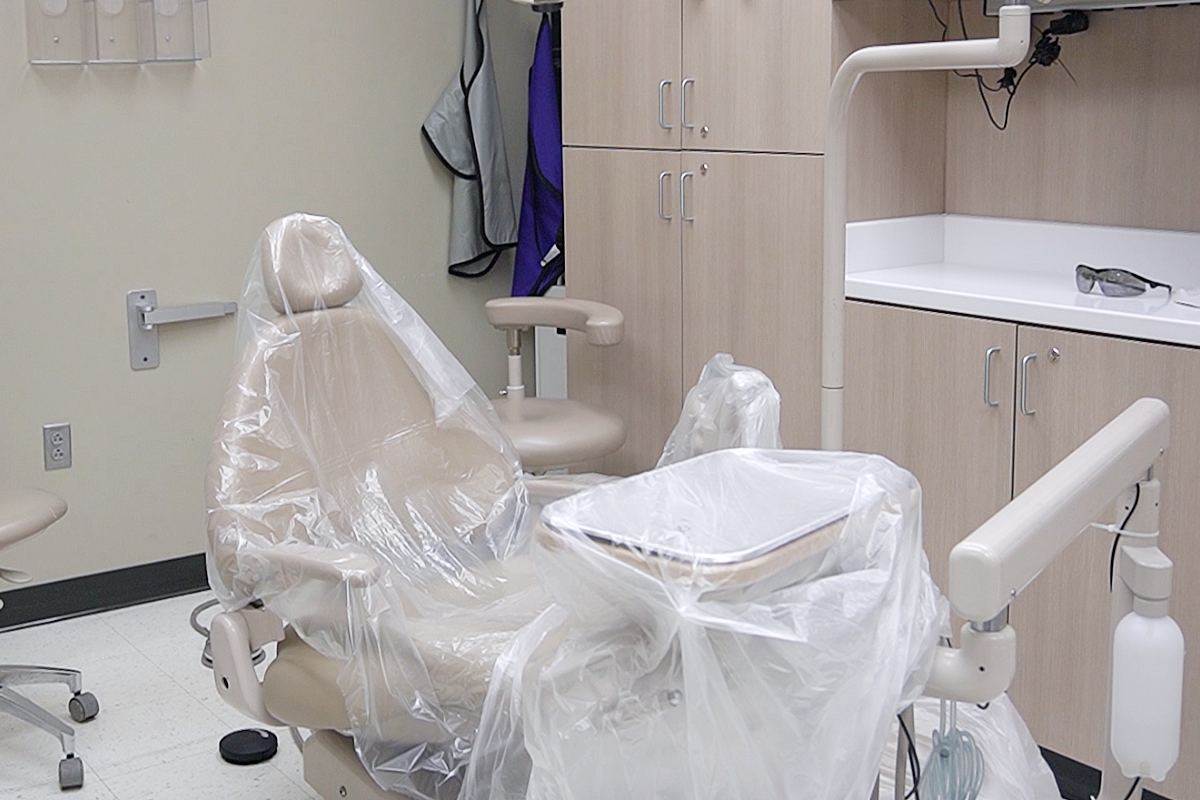
 The UAB Civitan-Sparks Dental Clinic
The bright lights, the unfamiliar hum of equipment, the sensation of having foreign hands in your mouth…going to the dentist isn’t exactly everyone’s favorite activity. But for some children, particularly children with autism, cerebral palsy, epilepsy, or other intellectual or developmental disabilities (IDD), these sensory experiences can be especially intense.
A simple checkup can be tension-filled as patients try to make sense of a space that feels overwhelming and unpredictable. These checkups are fraught for families, too, as they navigate dental care systems that are not always equipped to meet their children’s needs.
At UAB, one clinic is working to change that experience entirely. Sparks Dental Clinic, part of the Division of Developmental-Behavioral Pediatrics within UAB’s Department of Pediatrics, is co-directed by UAB Department of Pediatric Dentistry’s Kimberly Carr, DMD, M.S. and Stephen Mitchell, DMD, M.S.
Together, Drs. Carr and Mitchell, attending faculty, pediatric dental residents, and UAB School of Dentistry D3 and D4 students work as a team to ensure that, for the patients who come to Sparks Dental Clinic, hope lives in every appointment.
The Only Place Families Can Go
Patients come to Sparks Dental Clinic with needs other clinics simply cannot accommodate—children who need extra time to feel safe, patients whose muscle control makes positioning difficult, patients who cannot swallow easily and require extra suction, or individuals whose severe anxiety makes even seeing a dental light overwhelming.
Demand, however, outstrips capacity.
“We only have two chairs,” Dr. Mitchell says. “There’s more demand than we have capacity for, especially with the equipment we have right now.”
If a new patient calls today, the first available appointment, according to Dr. Mitchell, may be six or seven months out. Even procedures such as a filling require a wait of four to five months after the original appointment.
For families already navigating the daily challenges of disability, that wait can feel impossible.
What Sparks Dental Clinic Provides
For decades, Sparks Dental Clinic has been a lifeline for families across Alabama. As the only dental clinic in the state dedicated exclusively to patients with IDD, it offers more than dental care. It offers dignity, comfort, and compassion. “Sparks offers something families can’t find anywhere else,” says clinic director Dr. Stephen Mitchell.
His former student, Dr. Marcus Moss (UAB School of Dentistry, ’14), now a pediatric dentist in North Alabama, puts it plainly: “We are very fortunate in the state of Alabama to have a place like Sparks; it behooves all of us to step up. Sparks is the last stop on the train station for a lot of these families.”
Outdated Equipment, Real Risks
Sparks’ two operatories date to the 1990s. The chairs are at the end of their lifespan, and because the chair, unit, and light are all fused together they can no longer withstand the movements and physical needs of IDD patients.
“When a patient becomes scared and starts kicking, the chair can handle it,” Dr. Mitchell explains. “But the light and attached equipment can’t.”
The team dreams of removing both of the current operatories and replacing them with equipment that is broken down into three separate components.
“If the patient could simply see the chair first, without all the intimidating equipment surrounding it,” says Dr. Mitchell, “this would reduce fear for them and build trust in us.”
Equipment limitations also slow care and raise risks. The handpieces used for fillings require water to keep them cool, but the clinic’s suction tools are so weak that procedures are slowed considerably. Even more concerning is the panoramic x-ray machine cannot accommodate a patient in a wheelchair.
“To buy a new panoramic machine would be around $25,000 to $30,000,” Dr. Mitchell says. Without it, clinicians must rely solely on visual evidence to detect decay—sometimes leading to avoidable tooth loss.
“We All Have a Stake in Sparks”
Dr. Moss, Dr. Mitchell’s former student, remembers what the Sparks rotation meant for his own training.
“Not only does Sparks serve patients, but it gives residents the competency and expertise to provide this [kind of care] in their own practices,” he says. “That experience goes with you. A lot of dentists who train at UAB end up implementing what they learned at Sparks.”
But Sparks Dental Clinic’s role extends far beyond education. As Dr. Moss explains, it functions as a statewide safety net—one that many dentists rely on more than they realize.
Without Sparks, that safety net disappears entirely. This is why Dr. Moss believes the dental community has a responsibility to support the clinic.
“The least we can do, if we can’t take these patients in our practices, is to contribute financially,” he argues. “If you’re going to refer a patient, the least you can do is contribute or volunteer. We all have a stake in keeping Sparks going.”