 Dr. Jared Teeples, an Orthodontics resident at UAB SODOver the last two decades, clear aligner therapy has transformed the field of orthodontics as an alternative to traditional fixed appliances. Clear aligners offer a discreet treatment option that supports normal oral hygiene and provides additional benefits such as improved patient compliance during active treatment and retention. Align Technology has been at the forefront of innovation for clear aligner therapy. The introduction of G8 technology in 2020 enhanced the predictability of treating crowding, crossbite, posterior expansion, and deep bite cases.
Dr. Jared Teeples, an Orthodontics resident at the University of Alabama at Birmingham School of Dentistry, has conducted research investigating the efficacy of posterior expansion using G8 technology, specifically in younger patients. “With the increasing popularity of clear aligner therapy, it is important to look at how effective aligners are in cases that traditionally required fixed appliances.” The goal of his research was to evaluate alveolar bone remodeling outcomes in Phase I cases treated with clear aligner expansion. “Previous literature primarily examined expansion with clear aligners in patients with permanent dentition and was conducted prior to the release of G8 technology.” The specific aims of his research included comparing arch widths and alveolar bone thickness before and after treatment, as well as assessing the differences between planned and actual expansion in both arches.
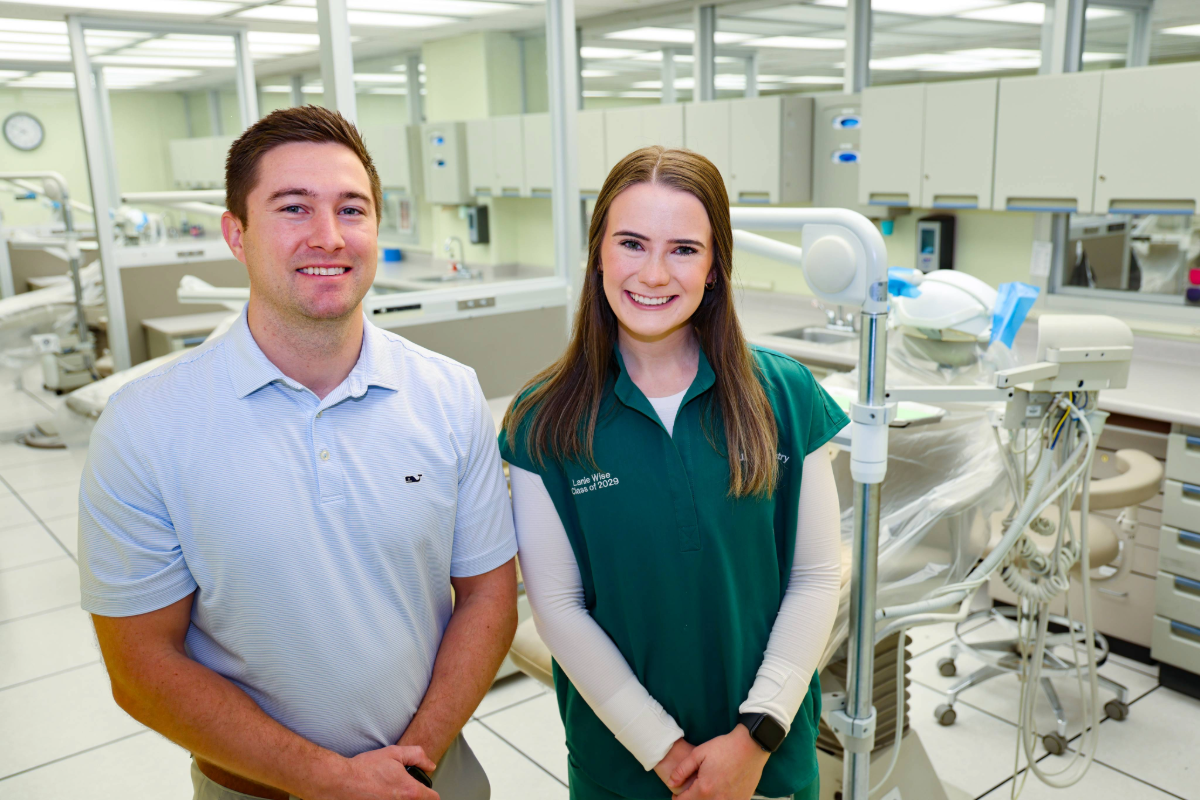 Dr. Teeples and Lanie Wise in the UAB Dentistry Orthodontics Clinic.To assess treatment outcomes, pre-treatment and post-treatment cone-beam computed tomography (CBCT) images were analyzed by measuring the molars and alveolar bone on both the maxillary and mandibular arches. Measurements for the maxillary first molars were taken on the coronal section aligned with the palatal roots, while those for mandibular first molars were taken on the coronal section aligned with the distal roots, except for the furcation, which was positioned more anteriorly.
Results showed that the achieved expansion for maxillary arch was greater than that reported in previous studies, which may be attributed to advancements in attachment design, such as those introduced with G8. In the mandibular arch, the achieved expansion was comparable to the planned expansion, which is consistent with the literature. Notably, the change in buccal bone thickness in the maxillary arch was minimal despite the increase in arch width. “The maxillary alveolar bone was able to adapt to the expansion forces without decreasing buccal bone thickness, which is common in traditional expansion appliances.” His findings indicated that a majority of the expansion of the maxillary arch was due to bodily movement of the molars rather than excessive tipping. In the mandibular arch, a slight reduction in alveolar bone thickness was observed, which may be attributed to molar eruption rather than excessive tipping.
Overall, Dr. Teeples found that clear aligner therapy could offer a less invasive alternative to traditional expanders for the correction of mild to moderate constriction in Phase I patients. “This research provides evidence of the effectiveness of clear aligners, which orthodontists can use to practice evidence-based dentistry.” His work highlights how advancements in clear aligners are shaping the future of orthodontic care and the importance of continued research on the new technology. “Further research is needed on the use of clear aligners for posterior expansion, but this study offers a meaningful first step toward expanding treatment options for patients.”
When asked what advice he would offer to prospective student researchers, Dr. Teeples emphasized the importance of mentors and staying up-to-date with the literature. “When trying to determine the focus of my research, I searched the literature to find recent innovations. Discussing my interests with faculty helped me to narrow down my research and to find topics that have not yet been studied.”
Story originally published in Vol IV, Fall 2025 Bridging the Gap, a newsletter of the UAB Local Student Research Group.