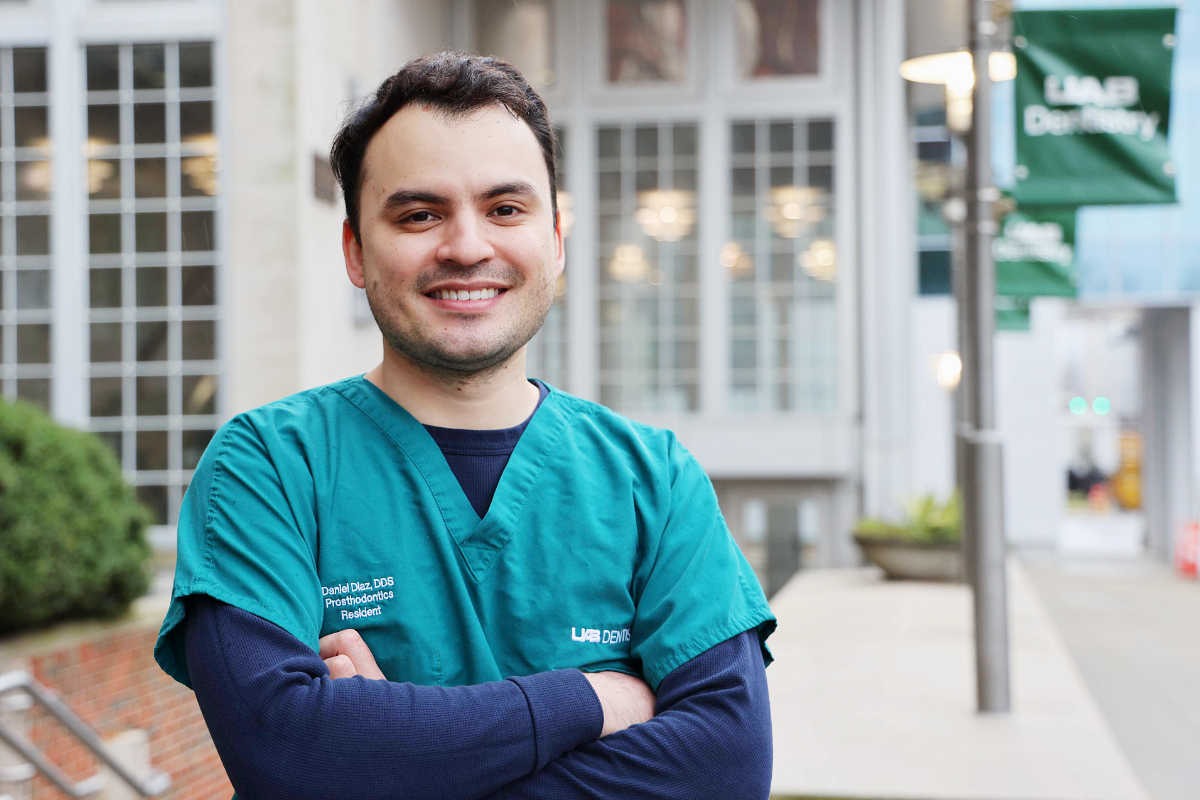
 For UAB prosthodontics resident Daniel Diaz, rigorous clinical training and collaborative care shape both his growth as a dentist and his sense of purpose.
The more Daniel Diaz, DDS, learns about dentistry, the more he learns about himself. That realization has taken shape during his time in the University of Alabama at Birmingham School of Dentistry’s Advanced Education in Prosthodontics residency, a program defined by complexity, collaboration, and comprehensive patient care.
Growing up in Guatemala, Diaz says he was initially more curious about science than medicine. His mother is a physician, which gradually exposed him to the medical field, but it was working with his hands that began to steer his interest toward dentistry.
“Then once I started dental school, I discovered how much I really enjoy it,” Diaz says. “Just the problem‑solving part of it, and the precision we need in treating our patients, interested me.”
Now in the final stretch of the three‑year prosthodontics residency, Diaz spends his days managing complex restorative cases that require careful diagnosis, long‑term planning, and close coordination with other dental specialties. The program prepares residents to take the lead in treatment planning for patients with advanced restorative needs, drawing on a broad range of clinical skills.
Before completing the program, residents receive extensive training in comprehensive treatment planning and restorative therapies, with an emphasis on detecting, diagnosing, preventing, and treating complex restorative conditions.
“The goal is to train residents to be able to manage challenging, multidisciplinary cases that require a high level of diagnosis and treatment planning,” says Chin‑Chuan Fu, D.D.S., M.S., chair of the School of Dentistry Department of Restorative Sciences. “After completing the program, a resident will be able to look at a patient’s case comprehensively and take the lead in working with other specialties to complete that care.”
While the residency can be demanding and often requires long hours, Diaz says he enjoys both the work and the people around him.
“When I first came to UAB, everyone was so welcoming,” Diaz says. “I met faculty during my interview who were super‑skilled in prosthodontics and capable of managing very complex cases, but at the same time they were very humble and friendly. They just want to see you grow and become better. That made me feel that this was a good fit.”
Diaz says the sense of community within the program extends to his fellow residents, who have become close friends.
“I’ve been very fortunate to work with colleagues who have become close friends,” Diaz says. “That makes it fun and creates a good environment where you don’t feel alone. Even though you’re working long hours, you always feel like there is someone there with you and for you. This program has a good combination of faculty excellence and a positive environment.”
Along the way, Diaz has also valued the opportunity to work with dental students as they begin clinical training. While teaching is not the primary focus of the residency, he says contributing to student learning has been meaningful.
“I remember being in their place not that long ago,” Diaz says. “So it’s very meaningful to me that I can contribute to their growth.”
Diaz also credits the support of his wife, Gaby Ramos, a dentist who put her practice on hold to join him in Birmingham during his residency.
“She has been my greatest supporter from day one,” Diaz says. “She’s always believed in me, and that’s made all the difference.”
As he prepares to complete the program, Diaz says the residency has helped clarify what kind of dentist he wants to be, grounded in comprehensive care, collaboration, and service to patients.
For Diaz, prosthodontics has become a path shaped by challenge, purpose, and a community committed to helping residents grow.