Rana Aldrees, M.D., a current PGY-3 resident in the UAB Department of Pathology, has been awarded with inaugural Ona Faye-Petersen Educational Support Fund.

Dr. Aldrees will be using the fund to attend an additional course at the annual meeting of the United States and Canadian Academy of Pathology, USCAP 2020 in Los Angeles titled, "Major Advances in the Diagnosis and Management of Breast Disease." She will be presenting a poster at the USCAP conference on March 2 titled, "Validation of the Revised 8th AJCC Breast Cancer Prognostic Staging System: Analysis of 5,321 Cases from a Single Institution."
A study published in the Journal of the American Society of Nephrology by researchers at the University of Alabama at Birmingham largely validates the hypothesis that a second immunoglobulin, IgG, is a crucial part of the pathogenic immunodeposits in glomeruli of patients with IgA nephropathy. UAB Department of Pathology faculty members Huma Fatima, M.D.,Associate Professor, Anatomic Pathology, and Lea Novak, M.D., Associate Professor, Anatomic Pathology, assisted in this study and co-authored, along with other UAB School of Medicine faculty, the JASN paper, "Glomerular immunodeposits of patients with IgA nephropathy are enriched for IgG autoantibodies specific for galactose- deficient IgA1."
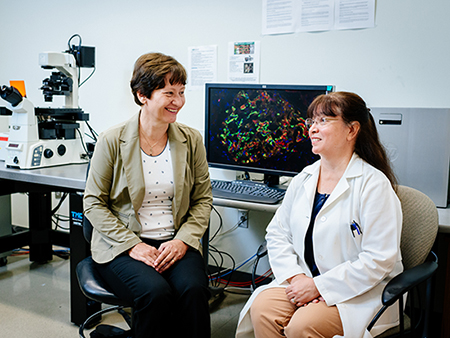 Lea Novak, M.D., UAB Department of Pathology and Stacy Hall, Research Associate, UAB Department of Microbiology
The most common form of the kidney disease called glomerulonephritis is IgA nephropathy. IgA nephropathy is believed to be caused by IgA1-containing immune complexes formed in the blood that ultimately deposit in the glomeruli- the filtering apparatus of the kidneys. When kidney glomeruli become damaged, the kidneys lose their ability to remove waste from the blood and to retain blood proteins, and the injury can lead to kidney failure.
In IgA nephropathy kidney biopsies, IgA1 is the main immunoglobulin detected in the glomeruli by a clinical test called routine immunofluorescence. But those tests were often failing to detect immunoglobulin IgG, which was believed to be another vital contributor to the disease.
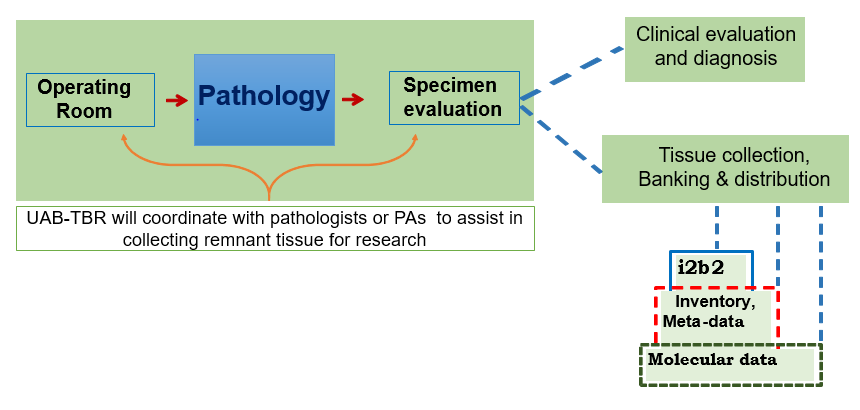
The UAB Tissue Biorepository (UAB-TBR), an important asset to the future of research at UAB, has officially launched. The UAB-TBR is housed in the Department of Pathology, and coordinated with the CCTS Biorepository.
A central commitment of the School of Medicine and the Health System is never to compromise our mission of patient care, as well as the safety and privacy of patients. With appropriate ethical and privacy guidelines, the UAB-TBR will collect, process, store, and distribute high-quality human tissue specimens to UAB investigators, including (but not limited to) the investigators of the O’Neal Comprehensive Cancer Center. The UAB-TBR will support clinicians and investigators in improving clinical care, while advancing personalized medicine.
The UAB Department of Pathology is excited to congratulate the 2020-2021 Chief Residents, Christine Pesoli, M.D., Anatomic Pathology Chief Resident and Benjamin Daggett, M.D., Clinical Pathology Chief Resident.

Page 93 of 120