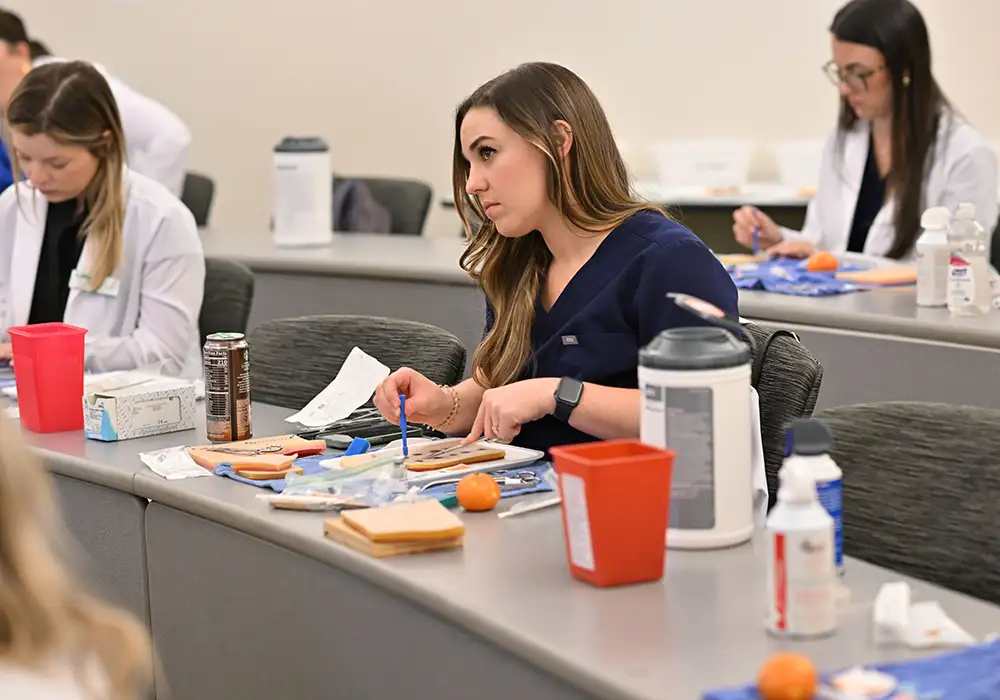
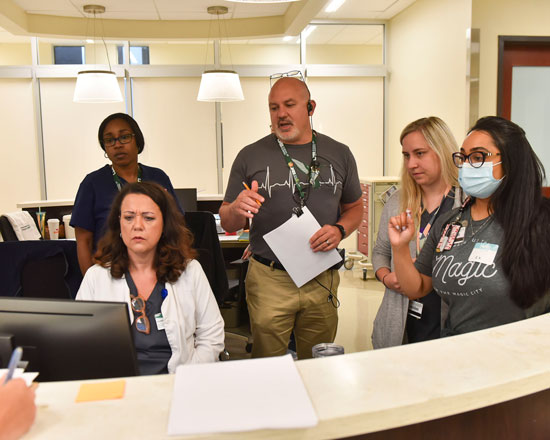
The Nursing Competencies Suite provides students the opportunity to learn their skills in a realistic hospital environment.
Our Competencies Suite features four rooms, including:
- Junior Board of Visitors Mother and Baby Competency Suite
- Sue Ellen and Mike Lucas Pediatric Nursing Competency Suite
These Rooms that can be customized to resemble various healthcare settings, including an emergency room, Intensive Care Unit (ICU), an ambulatory care area, long-term care setting, single patient maternity room and more. These rooms are equipped with high-fidelity features, including real hospital headwalls, wall-mounted monitoring devices, intravenous pumps and oxygen delivery systems, with each room having a dedicated crash cart and defibrillator duplicating those seen in a real clinical setting.
Specialized equipment, including birthing simulators and pediatric cribs are brought into the rooms depending on the training scenario. The Nursing Competencies Suite also has the Jane Kerlin, BSN, RN Nursing Competencies Suite Reception Area that provides a realistic entry point for scenarios, the fully equipped Fay and Linda Ireland Nurses Station and individual control rooms to ensure a comprehensive and controlled training experience.
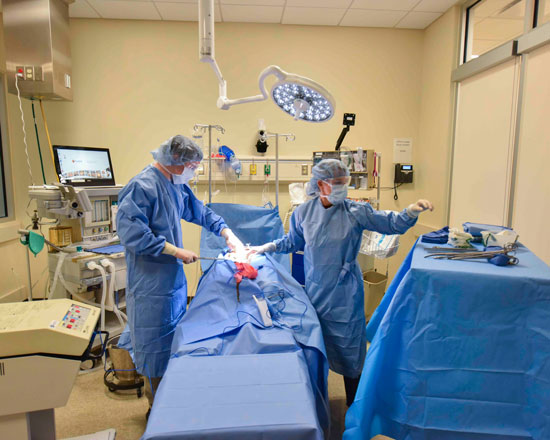
The Board of Visitors Operation Room Simulation Lab, the fifth room in the Nursing Competencies Suite, trains students specializing in surgical or anesthesia pathways in the skills they need to be successful in its advanced simulated operating environment. This realistic environment mimics the complexities of a real OR, offering a safe space for students to develop critical skills and confidence. RN First Assist and Nurse Anesthesia students practice real-world scenarios, preparing them for the demands of the surgical setting.
The OR is equipped with the latest state-of-the-art medical equipment, including:
- Simulated gases in a fully stocked anesthesia cart.
- Complete intubation setup with laryngoscopes, endotracheal tubes, stylets, and video laryngoscopy systems.
- A high-fidelity model capable of simulating various clinical scenarios, including hemorrhage and airway management.
- Fully adjustable OR bed, and overhead surgical light replicating the lighting conditions of actual operating rooms.
- A comprehensive set of surgical instruments, all meticulously maintained, and a working scrub sink for practicing proper hand hygiene techniques.
In addition, the Operating Room Control Room, given in memory of Alice Galbraith Beatty by Ruth Beatty Craddock, PhD, RN, enhances learning by recording simulations for review and real-time scenario changes. This allows students to practice critical decision-making and hone communication, teamwork, and critical thinking skills – all essential for success in the OR.
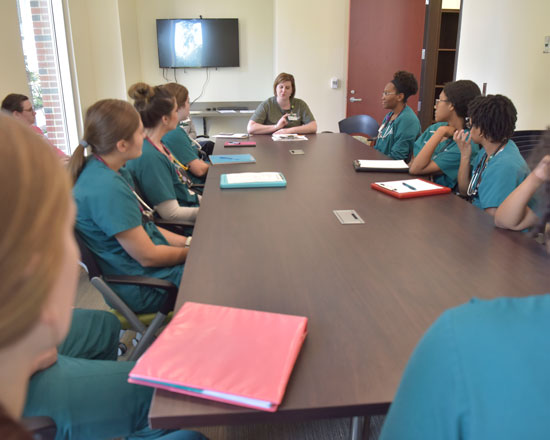
Prebriefing and Debriefing are both vital parts of the simulation experience, which is why we have three designated rooms, including the Daniel Foundation of Alabama Debriefing Classroom, for students to engage together and with faculty to begin and complete their simulation experience.
In the prebriefing stage, students receive clear goals, review relevant information, and clarify expectations. Faculty explain the scenario, highlight potential difficulties and offer guidance. This equips students for the simulation and encourages teamwork and communication.
Debriefing is a critical reflection space for students. After a simulation is complete, students analyze their actions, decisions and communication in a supportive environment. Facilitators guide open discussions about successes, areas for improvement, and alternative approaches. This helps students identify knowledge gaps, improve clinical judgment and develop strategies for future situations.
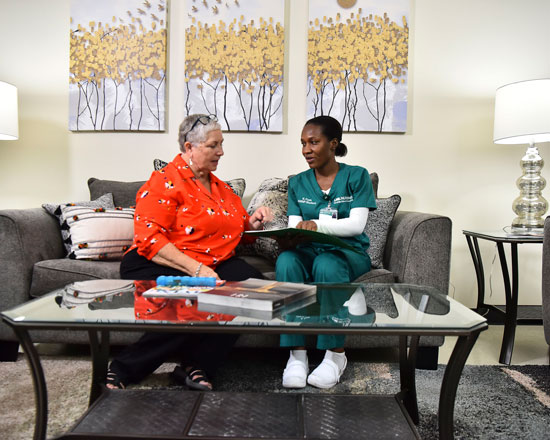
The Alacare Home Health & Hospice Nursing Skills Suite, in honor of Susan B. Brouillette, MPA, MBA, Chief Executive Officer, is a simulation lab designed to look and function like a real home. It lets students practice essential home healthcare skills in a safe, comfortable and supportive controlled environment.
The suite has a full working kitchen, bathroom, bedroom, and living area. This flexible space allows instructors to create realistic scenarios for different learning experiences for students to help improve their clinical judgment, communication skills and ability to handle the ever-changing environment in the home health settings. It also has video recording and playback technology so students can review their performance and get feedback from instructors.
This comprehensive and engaging learning experience makes the suite a valuable resource for home health education.