
What is a Digital Portfolio?
Digital Portfolios (also known as ePortfolios) are collections of artifacts chosen to showcase specific skills, experiences, and ideas. They are meant to be shared with peers, instructors, mentors, and potential employers. Portfolios can include artifacts from the past, present, and future ambitions.
Types of portfolios
Three main types of portfolios are common in higher education:
- Showcase: collection of best works and achievements
- Academic: display of learning progress with a focus on feedback
- Assessment: shows competency/proficiency/accountability
Why You Should Use a Digital Portfolio
Digital portfolios have many advantages over print. Not only are they easily customizable, but they also offer many benefits, such as:
- Inclusion of multimedia and digital badges
- Transferable to professional environments
- Infinite audience
- Immediate feedback
- Content easily updated
- No paper copies required
UAB-Provided Digital Portfolio Tools

Other External Digital Portfolio Tools
|
TOOL |
COST |
DOWNLOADABLE |
HOSTING |
|---|---|---|---|
|
Free |
No |
Free |
|
|
Free or Pro ($$) |
Yes |
Based on subscription |
|
|
Free or Personal ($$) |
Yes |
Based on subscription |
|
|
Free or Premium ($) |
Yes |
Free; paid personalized hosting |
|
|
Free or Premium ($$) |
Yes |
Free; paid personalized hosting |
Expectation
Learning online requires access to internet and a device (laptop, tablet, etc.). In some courses, you may be required to have additional software, a webcam, etc. If you do not have the technology required for your course, please contact your instructor to discuss alternatives as soon as possible.
DSS Accessibility Statement
UAB is committed to providing an accessible learning experience for all students. If you are a student with a disability that qualifies under Americans with Disabilities Act (ADA) and Section 504 of the Rehabilitation Act, and you require accommodations, please contact Disability Support Services for information on accommodations, registration, and procedures. Requests for reasonable accommodations involve an interactive process and consist of a collaborative effort among the student, DSS, faculty, and staff.
If you are registered with Disability Support Services, please contact DSS to discuss accommodations that may be necessary in your course. If you have a disability but have not contacted Disability Support Services, please call (205) 934-4205, visit the UAB DSS website, or visit Hill Student Center Suite 409.
DSS Contact Information
- Phone (Voice): (205) 934-4205
- TDD: (205) 934-4248
- Fax: (205) 934-8170
- Email: dss@uab.edu
Getting Started
UAB courses are hosted in the Canvas Learning Management System. To access your courses, follow these steps:
- Access Canvas:
- Go to uab.instructure.com. Enter your BlazerID and password.
- Or, go to uab.edu/blazernet. Enter your BlazerID and password. Click on Enter BlazerNet. Under the Student tab, select the Canvas button located on the right side of the screen.
- Your courses should be located on the Canvas dashboard. If you cannot see your courses, follow these instructions.
- Your instructors and peers in your Canvas courses will be using Canvas tools to communicate important information about your courses. You will need to customize your Canvas notification preferences to decide how often you want to be notified. It is recommended that you select to be notified “Right Away” or “Daily” so you do not miss important information.
- If you need help logging into Canvas or locating your courses, Canvas technical support is available 24/7, 365 days a year. Each of the support options below are also available from the Help button on the far left global navigation menu when logged into Canvas.
- Submit a Ticket
- Live Chat
- Call (833) 519-8477
- To learn how to use Canvas, view the UAB Canvas webpage for tutorials and guides.
- You can access Canvas on your mobile device utilizing the Canvas Student Mobile App (iOS or Android).
Tips for Success
Time Management
Please remember that while your courses are online, these courses have assigned readings, learning activities, and assignments with due dates. In order to be successful in your courses, it is important that you prepare by following these tips.
- Review the course syllabus and course schedule to check assignment due dates.
- Schedule time each day to work on course activities.
- Maintain a To-Do list, action list, or a calendar with due date reminders.
- Prioritize urgent and important tasks.
- Do not wait until the last minute to complete assigned readings, activities, and assignments.
- When you have questions about your course content, reach out to your instructor as soon as possible.
Netiquette
Communication — Clear and regular communication between you and your instructors and peers is important to your success.
- Use your UAB email or Canvas Inbox for all course-related email. Each instructor will have a preferred method for email, so identify which method is preferred for each instructor.
- Check your email daily.
- Do not discuss grades or personal matters (Example: health, financial problems, etc.) publicly in Canvas discussion boards, group emails, or web conferences. Discuss these matters privately with the instructor.
- Use professional language and be respectful when communicating with your instructor and peers.
- Do not type in ALL CAPS as that signifies screaming.
- Avoid sarcasm or irony in responses when you disagree.
- Be respectful and diplomatic (i.e., remember the human reading your message).
- Avoid jargon and abbreviations you would use on social media or in text messages.
Commonly Used Academic Technologies
In addition to Canvas, your instructors may require the use of additional academic technologies. The following are the most commonly used technologies. For the full list of academic technologies and support guides, please visit the Academic Technologies page.
- Microsoft Office — As a UAB student, you have free access to Microsoft Office 365 and 1Tb of file storage.
- Adobe Reader — A free PDF file viewer that can open and interact with all types of PDF content, including forms and multimedia.
- Zoom — A web conferencing tool that can be used to attend live lectures/meetings, virtual office hours, student group meetings, etc.
- Turnitin — A tool used to check for plagiarism and improve student writing.
- ProctorU — A live proctoring solution used to proctor online exams.
- Respondus Monitor — An automated proctoring solution used to proctor online exams.
You may encounter additional required technologies. For the full list of academic technologies and support guides, please visit the Academic Technologies page.
UAB Resources
Many UAB resources are available to distance students, including but not limited to the following:
- University Writing Center — Offers free writing help to all UAB students.
- UAB Libraries — Provides a set of library resources to help you continue with your coursework.
- Disability Student Services (DSS) — Collaborates with students, faculty, and staff to provide the resources and assistance needed for students to have an accessible university experience.
- UAB IT for Students — Provides consistent, accessible, personalized and collaborative environments to enhance the student experience.
- Vulcan Materials Academic Success Center — Services provided include tutoring, supplemental instruction, academic advising, success advising, workshops and study hours.
Additional resources and services are available on the One Stop website.
Support Contact Information
- If you need help logging into Canvas or locating your courses, Canvas technical support is available 24/7, 365 days a year. Each of the support options below are also available from the Help button on the far left global navigation menu when logged into Canvas.
- Submit a Ticket
- Live Chat
- Call (833) 519-8477
- If you need help with any other academic technology, please visit the eLearning Academic Technology Help page for technical support information.
- If you have questions related to course content, please reach out to your instructor. You can locate your instructor contact information in your Canvas course, by clicking on the People link on the course left navigation menu. If the People link is not available in your Canvas course, you can locate your instructor name in BlazerNet.

There are a variety of tutoring services available to students at UAB. Use the information below to select the best option for you.
Campus Wide Tutoring Services
VMASC Tutoring
Tutoring at the Vulcan Materials Academic Success Center (VMASC) is a FREE, peer-facilitated academic support service. VMASC tutors work with students to identify and mobilize resources that promote independent learning and academic success. All tutors are undergraduate students who have excelled in the course(s) in which they tutor, and have been trained to facilitate discussions on course content, study skills, and effective habits for academic achievement.
Available to: All UAB undergraduate students
Subjects: Biology, Chemistry, Mathematics, Psychology, & Sociology
Format: Scheduled virtual or in-person
Hours: Monday-Friday, various hours from 8am-7pm
University Writing Center (UWC)
UWC helps students grow as writers. They can help any UAB student with any kind of writing project and at any stage of the writing process. In friendly one-on-one sessions, our experienced, trained tutors are happy to help with all writing needs. They most commonly help with revising, editing, outlining/drafting, improving citing skills, incorporating sources, understanding writing assignments, and brainstorming ideas.
Available to: All UAB students
Subjects: Any kind of writing project
Format: Asynchronous online submission or live in-person or virtual sessions
Hours: Monday-Saturday, various hours from 9am-8pm
Career Center
The Career Education and Readiness Team provides students with industry-specific assistance equipping them to pursue meaningful careers. Students can schedule an appointment with a Career Advisor or take advantage of their walk-in services.
Available to: All UAB students
Subjects: Resumes, interviews, career exploration, etc.
Format: Virtual scheduled sessions or virtual walk in sessions
Hours: Monday-Friday, 9am-4pm
College/Program Specific Tutoring
College of Arts and Sciences
Collat School of Business
School of Engineering
INTO UAB Learning Resource Center
Per the Department of Education (September 2020):
Regulated professions in the United States are generally licensed at the state level, and most licensed professions require some formal postsecondary education or training as a prerequisite for entry. The competent authority for recognizing professional qualifications is generally the appropriate state or territorial licensing authority in the jurisdiction where one intends to work.
Since professional licensure is generally regulated at the state level, it is usually necessary to obtain a separate license for each state in which one wishes to practice. In some instances, reciprocity agreements are in place to make it easier for someone who already holds a license in one state to obtain a license in another state. However, the degree to which such reciprocity exists can vary widely depending on the profession and the states involved.
The term “certification” generally refers to a function administered by a nongovernmental organization, which is intended to further recognize professional competence based on having met the quality standards of the organization.
 Professional licensure and certification requirements vary from state to state. Federal Regulations 34 CFR §668.72(c)2 and 34 CFR §668.43(a)(5)(v) require UAB to provide public or general disclosures on educational programs designed to meet educational requirements for a specific professional license or certification, that is required for employment in an occupation, or is advertised as meeting such requirements.
These disclosures are strictly limited to the program’s determination of whether its educational program, if successfully completed, would be sufficient to meet the educational licensure requirements in a particular state. This determination is based on the educational and curricular requirements of each state for licensure (excluding any special or temporary licensure that may be granted) and does not imply that other requirements for licensure do not exist or have been determined to have been met by this program or that any necessary approvals for clinical placements have been secured at the time of enrollment. UAB cannot provide verification of an individual’s ability to meet licensure or certification requirements unrelated to its educational programming. Such individual determinations are made by state licensing boards. These disclosures do not provide any guarantee that any particular state licensure or certification entity will approve or deny a student’s application.
UAB has made every effort to provide accurate information; however, state laws/regulations are subject to change at any time. Enrolled and prospective students are strongly encouraged to contact their state’s licensing body for information and guidance on licensure requirements for the state where they are located or where they plan to practice.
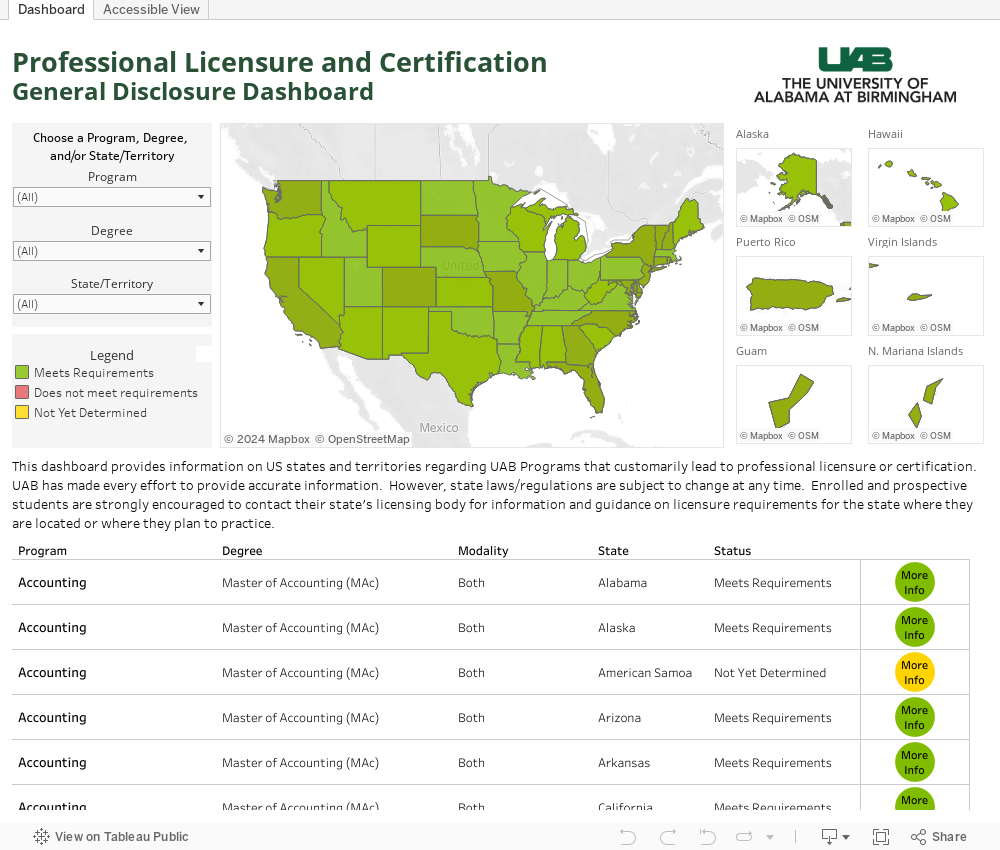
Please see the dashboard below for information on our programs that customarily lead to professional licensure or certification, for where you are located or the location you hope to practice in.
Internationally Located Students Interested In UAB Programs Enrollment
Students not living in the United States, Puerto Rico or the U.S. Virgin Islands, and interested in enrolling in an online program should be aware that your country may or may not regulate distance education. The University of Alabama at Birmingham (UAB) has not determined if your country requires foreign higher education institutions to comply with their distance education regulations.
Currently, UAB cannot guarantee that a Program that could lead to Professional Licensure or Certification meets curriculum requirements, or professional licensure or certification requirements, in any country outside of the U.S. If an internationally located student is interested in enrolling in a UAB program that could lead to a professional license or certification, they should contact the appropriate professional licensing board in the country where they intend to work in order to determine whether a degree from UAB will fulfill the requirements for that country.
It is the student’s responsibility to contact appropriate authorities in the country in which they are located or wish to be employed, to determine if successful completion of a UAB Program will be accepted for the occupation of their choosing.
Sanctioned Programs and Countries
Due to current restrictions imposed by U.S. Department of Treasury’s Office of Foreign Assets Control (OFAC), UAB online courses cannot be provided to the countries listed below. Students who are located in one of these countries or may become located in any of these countries during their course of study, should not enroll or begin an academic program at UAB.
The sanctioned countries can be found here, Sanctions Programs and Country Information, and currently includes the following:
- Cuba
- Iran
- North Korea
- Syria
- Ukraine/Russia
- Venezuela
Please refer to UAB’s Export Control Policy and Transparency in Research for more information.