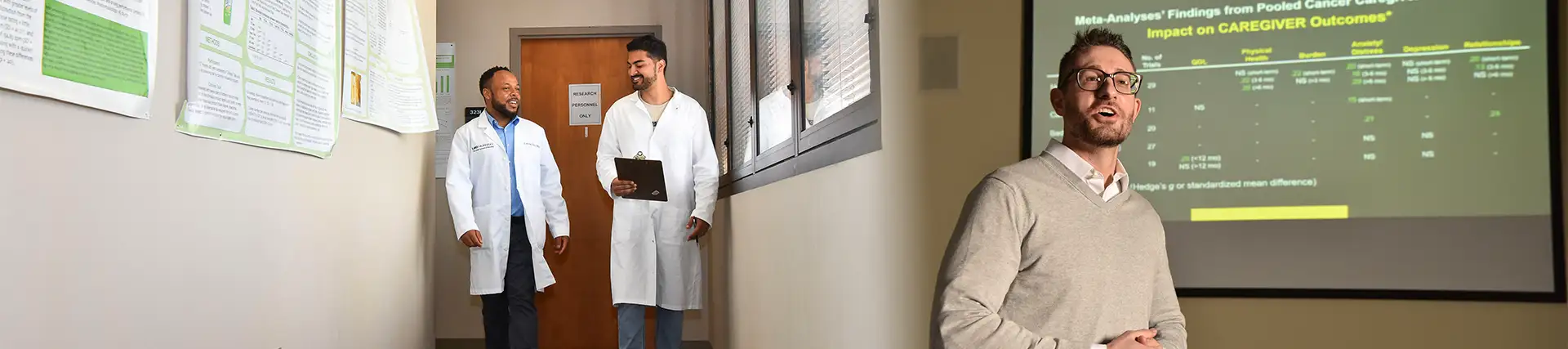
Researchers in this area are focused on developing cutting-edge technologies to address societal challenges with a focus on technologies and products. Technologies include bioinformatics and genomics, artificial intelligence, data science, and computer science. Products are developed using bioengineering and material science among other methodologies.

Edwin Aroke, PhD
Scholarly Projects
Epigenomic and Gene Expression Signatures of Racial Differences in Chronic Low Back Pain
NIH/NIAMS R079178
The purpose of this study is to compare DNA methylation patterns in 100 people with chronic lower back pain. We will also determine whether differential DNA methylation correlates with differential gene expression in our study participants.
Epigenomic and Gene Expression Signatures of Racial Differences in Chronic Low Back Pain
3R01AR079178-04S1
This project will foster a better understanding of the relative influences psychological, social, and epigenomic factors have on chronic lower back pain and will also give insight into the mechanism the drives racial disparities in chronic lower back pain. The proposed project is in response to NIAMS RFA-AR-20-001, Mechanistic Ancillary Studies to Ongoing Clinical Projects. This work lays the foundation for a long-term program of research in developing targeted interventions to reduce chronic lower back pain disability and improve outcomes for racial minorities.

Reed Bratches, PhD
Scholarly Projects
Biometrics for Evaluating Anxiety and Mood in Caregivers of Older Adults with Neurodegenerative Dementia (BEACON)
Garmin/Fitrock
This is a pilot trial where participants will receive a Garmin smartwatch and have their biometrics tracked for the study period. They will also complete two short surveys per day to see how anxiety, mood and caregiving tasks may correlate with their biometric data.
Family Caregiver Strategies to Manage Medication Refusals
Integrative Center for Aging Research and the Center for Palliative and Supportive Care
This is a mixed-methods study to understand caregiver responses to managing persons with dementia who refuse or resist their medications.

Jae Chul Lee, PhD
Scholarly Projects
Dr. Lee’s research spans state and national levels, addressing disparities in healthcare access, preventive services, reproductive and sexual health, oral health, and clinical trial participation. He employs both quantitative and qualitative methods, analyzing large-scale population-based surveys (BRFSS, MEPS, NHIS) and Medicaid claims data, and conducting interviews, focus groups, and statewide surveys.
Collaboration is central to his approach. He has worked with diverse stakeholders—people with disabilities, caregivers, advocacy organizations, healthcare providers, and policymakers—to ensure research translates into improvements in practice and policy. Guided by a health equity and social justice framework, Dr. Lee focuses on systems-level solutions, such as improving disability cultural competency among healthcare and public health professionals and advancing under-researched areas of disability health.

James Nicholas Odom, PhD
Scholarly Projects
A Mixed Methods Exploration of the Values Elicitation Experiences of Patients with an LVAD and their Family Caregivers
Sigma/HPNA
Co-PI: Avery Bechthold
This convergent mixed methods dissertation study focuses on exploring facilitators and barriers to values discussions between patients with a left ventricular assist device (LVAD), their family caregivers, and the healthcare team.
BMT-Care: Randomized Trial of a Psychosocial Intervention for Caregivers of Patients Undergoing Hematopoietic Stem Cell Transplantation
R01CA282182/Massachusetts General Hospital
The purpose of this study is to test the effectiveness of a multimodal psychosocial intervention for improving quality of life and reducing caregiving burden for caregivers of patients undergoing hematopoietic stem cell transplantation.
Decision Support Training for Advanced Cancer Family Caregivers: The CASCADE Factorial Trial
NIH/NCI/R01CA262039
A priority focus in oncology and palliative care is preparing the 3.2 million US family caregivers of persons with cancer to effectively partner with patients in health-related decision making from diagnosis to the end of life, particularly in underserved settings. Over 70% of patients with cancer involve relatives, friends and partners in healthcare decisions, including choices about cancer treatments, surgery, transitions, location of care, accessing palliative and hospice care, and many others. Patients making healthcare decisions with unprepared family caregivers may experience inadequate family decision support leading to heightened distress and receipt of care inconsistent with their values and preferences, which may in turn increase distress for family caregivers.
Lay Coach-led Early Palliative Care for Underserved Advanced Cancer Caregivers
NIH/NCI/R37CA252868
The burden placed on family caregivers and the toll on their mental and physical health have never been greater and will continue to rise; by 2026 the number of individuals with cancer is expected to be over 20 million and in 2019, the number in their last year of life was over 600,000. Healthcare clinicians should be concerned with the health of family caregivers for their own sake, but also because these caregivers deliver over 80% of the home care to community-dwelling patients with advanced illness. It is thus imperative that interventions be developed that keep caregivers healthy and functioning, not only for their own sake, but also so they can provide the best care possible to patients with cancer.

Ellen Smith, PhD
Scholarly Projects
Cancer Control and Prevention T32 Training Program Competitive Renewal: Focus on Health Disparities
2T32CA047888: Institutional Research Training Grant
The overall objective of the T32 Training Grant is to develop scientific research capacity through training of pre- and post-doctoral scholars with interest in building careers in cancer prevention and control research and addressing associated health disparities.
Duloxetine to Prevent Oxaliplatin-Induced Chemotherapy-Induced Peripheral Neuropathy: A Randomized, Double-Blind, Placebo-Controlled Phase II to Phase III Study
NIH/NCI/R01CA235726
This randomized controlled trial will test a well- tolerated, widely available, non-opioid, preventive treatment for a debilitating chemotherapy side effect (oxaliplatin-induced peripheral neuropathy (OIPN)) experienced by millions of cancer survivors, for which there is no good treatment.
ICE COMPRESS: Randomized Trial of Limb Cryocompression versus Continuous COMPRESSion versus Low Cyclic Compression for the Prevention of Taxane-Induced Peripheral Neuropathy
SWOG S2205 – NCT#05642611
The main objective of this 3-arm randomized study is to test ccyrocompression to prevent taxane-induced peripheral neuropathy in patients with breast and GYN cancers.
International Chemotherapy-induced Peripheral Neurotoxicity (CIPN) Assessment and Validation Study (CAVS)
UAB Intramural Funding
The purpose of this study is to test the psychometric properties of varied assessment approaches for chemotherapy-induced peripheral neurotoxicy in diverse neuropathy types.

Hsiao-Lan Wang, PhD
Scholarly Projects
A Motion Exergaming Approach to Promote Self-Managing Fatigue and Pain after Head and Neck Cancer Treatment
NIH/NCIR01CA244947
Fatigue and pain are two high incident symptoms threatening survivals among head and neck cancer patients after their treatment. For 6 weeks, the intervention group will receive a home-based Physical Activity intervention with fitness graded Motion Exergames (PAfitME), and the attention control group will receive NCI- based survivorship education and exergame equipment. We will test whether or not PAfitME is effective to improve fatigue, musculoskeletal pain, functional status, and QOL during the critical transition period from the treatment endpoint to self-management at home.
Reducing Health Disparity of Physical Functioning Among Young Adult Cancer Patients of Color
Oncology Nursing Foundation
There is a lack of knowledge addressing health disparity in cardiorespiratory fitness and muscle strength among young adult (20-39y/o) cancer patients of color. PAfitME, a Physical Activity intervention with fitness graded Motion Exergames, is a personalized, low-cost, telehealth, home-based program. Exergame Grading Scheme is an instrument that PAfitME uses to measure training intensity. This training intensity will be matched to each individual’s fitness capacity, so a personalized exergame prescription can be developed in the individual training plan. The study aims to pilot test of PAfitME effectiveness among young adult cancer patients of color on cardiorespiratory fitness and muscle strength.
The Role of Vision Function Over the Course of Head and Neck Cancer Treatment
UAB Vision Science Research Center
Vision toxicity from radiation has been addressed in the Head and Neck Cancer Survivorship Care Guidelines by the American Cancer Society and the American Society of Clinical Oncology. We propose a longitudinal study to preliminarily examine vision function in head and neck cancer patients (N=50) before, during, and a month after cancer treatment (radiation or chemoradiation) completion.
Learn more about UAB's Vision Science Research Center Polot GrantsOpens an external link.

Bryan Wilbanks, PhD, DNP
Scholarly Projects
Dr. Wilbanks’ research interests include: the impact of electronic data-entry interface design on documentation quality, documentation efficiency, and user-satisfaction; the role of documentation quality in patient safety and outcomes; and improving clinical practice and evidence-based guidelines through anesthesia related closed-claims studies.