Environmental Health & Safety has launched the new EHS Assistant (EHSA) system. To ensure ease of adoption and understanding, it is rolling out in phases. During each phase, EH&S will contact and arrange an orientation followed by access to the system. Access to the system will not be granted until orientation is complete. For questions, contact EH&S at EHSASupport@uab.edu
Automatic External Defibrillators (AED’s) are placed around campus in various locations. Below is a current map of which buildings house AED’s. If you are interested in purchasing AED’s, please reach out to campus safety for guidance on the proper procedures for doing so and the maintenance requirements you should adhere to. Please note: currently each AED owner is solely responsible for maintaining their AED’s and servicing them as needed.
Bomb threats are normally made over the telephone to an unsuspecting person and are primarily intended to disrupt and cause chaos. Historically, threats have strictly been threats, and usually that is all the caller intends.
Making a false bomb threat is a federal offense and punishable under U.S. Code, Title 18, Part I, Chapter 40, section 844(e), with a penalty of up to ten years in prison, $250,000 fine, or both. This penalty also applies to juvenile offenders.
When a bomb threat is called in, record all the pertinent information using the bomb threat checklist.
- Do not hang up the telephone. This is extremely important in conducting an investigation and in possibly locating the caller.
- Be calm, be courteous and listen. Do not interrupt the initial message of the caller. If possible, notify your supervisor immediately by a pre-arranged signal while the caller is on the line.
- ALWAYS CALL UAB POLICE. NEVER ASSUME THE CALL IS A HOAX.
- Call 911 from any UAB telephone. If you use a cell phone, dial 934-3535.
- Do not advise anyone else of the threat except for your immediate supervisor.
- Stay calm and wait for the arrival of the Police. They will consider the facts and conduct a complete investigation.
If you find a potential device, or are advised of a potential location of a device, immediately call the UAB Police. Don't touch or move the device.
If you suspect a letter bomb, follow the same procedure for finding a possible or real device.
All emergencies require proper planning. Proper planning involves the processes of mitigation, preparation, response and recovery. We like to use the equation:
Do the people in your building or department know what to do in case of fire? What about during a severe weather event? Each building at UAB should have a Building Disaster Plan, and all employees should be trained on the actions they should take during emergencies.
In preparation for emergencies, EHS has provided tools to assist you in developing your plan. Keep in mind that your plan must integrate with the overall plan for your building and the University. Below are the Severe Weather Gathering Points for your area, as well as a template for developing your Building Emergency Action Plan.
Severe Weather Gathering Points
Building Emergency Plan template

EHS will be happy to assist you with any planning needs or answer any questions about the template.
Please contact Robert Emmons, Campus Safety Manager, at remmons@uab.edu or 205-934-0063.
The building Emergency Response Plan is now a uniform plan, developed in coordination with emergency management that applies to all buildings. If additional information is needed, such as supplemental information regarding location of severe weather gathering points, storm shelters, corral points, or plans for specific hazards regarding your facility, a separate document can be maintained for your needs. Campus safety is able to assist building administrators with developing/reviewing plans as needed.
Severe Weather Gathering Points
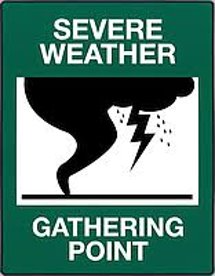
Severe weather gathering points are located around various campus buildings. The severe weather gathering points identification is an on-going process, and we retain an internal list. As we conduct facility inspections, we review these locations and make updates, as necessary. if you need help identifying your severe weather gathering locations, or do not currently have designated locations please reach out and we can schedule a consultation to review appropriate locations, or inform you of the locations we have per our internal list. The sign below is typically designated as a severe weather gathering point. You may see these in your building towards the lower levels of the building, or interior spaces as an example.